# Introduction to Carbon

Crypto perpetuals + TradFi Markets. One account. Institutional execution. On-chain rails.

## <mark style="color:$info;">The Onchain Prime Broker for Global Markets.</mark>

Carbon is a decentralized derivatives venue that brings crypto and traditional markets into one on-chain account. Live today: 530+ crypto perpetual pairs and 150+ 24/7 RWAs with 282 TradFi Markets across stocks, forex, indices, and commodities, for 950+ markets in a single wallet, with new markets added every week.

Trade with wall street liquidity, the lowest cost of execution and stable rates.

Built like a prime broker. Accessible like a DEX.

***

### Two ways to trade real-world markets

Different traders need different things. Carbon offers real-world exposure two ways, both on-chain, both from the same account.

**Carbon TradFi.** 250+ markets, hedged 1:1 at regulated TradFi venues, with real market pricing during market hours, benchmark-anchored overnight rates, and liquidity sourced from where these assets actually trade. This includes hundreds of markets you will not find on any 24/7 venue. Built for traders who want execution that tracks the real market tick for tick.

**24/7 RWA markets.** 150+ real-world markets that trade around the clock, on-chain, even when the underlying exchange is closed. Always-on access to stocks, indices, and commodities, with the speed and composability of crypto perps. Built for traders who want to react the moment news breaks, day or night, weekend or holiday.

About 40 assets are available both ways, so you can pick the mode that fits the trade. Everywhere else, the two line-ups are different: 24/7 markets for always-on access, Carbon TradFi for real-market execution and far broader coverage. Carbon is the venue that offers both, in one account.

### Crypto perpetuals

530+ crypto perpetual pairs, executed through a network of third-party solvers competing on price and settled on-chain through Carbon's Automated RFQ (ARFQ) rails. Deep liquidity, stable rates, and up to 75x leverage.

<figure><img src="https://3351097766-files.gitbook.io/~/files/v0/b/gitbook-x-prod.appspot.com/o/spaces%2FbpemdioXs8P0YBsLx7uh%2Fuploads%2FrZ8ZEXOxcH6AHTMrUncT%2Fimage.png?alt=media&amp;token=74e300a6-a1f2-4fcf-81bb-37dfdd6bdb88" alt=""><figcaption></figcaption></figure>

***

### <mark style="color:$info;">Our Mission</mark>

Make derivatives trading on global markets accessible on-chain, with deep liquidity, transparent execution, and self-custody by default.

We are building the infrastructure for a future where any trader can access any market, instantly and securely, from any wallet, without KYC.

***

### <mark style="color:$info;">Our Vision</mark>

A single on-chain venue where every asset class (crypto, stocks, indices, forex, commodities) trades with the speed and depth of traditional finance.

Carbon is the core execution layer for ARFQ trading: solving liquidity fragmentation and execution bottlenecks with a model that is provably solvent, capital efficient, and easy to integrate.

Today: 530+ crypto perpetual pairs and 420+ RWA pairs live. Next: thousands of TradFi markets next to all crypto perpetual markets.

<figure><img src="https://3351097766-files.gitbook.io/~/files/v0/b/gitbook-x-prod.appspot.com/o/spaces%2FbpemdioXs8P0YBsLx7uh%2Fuploads%2FuaA26jZUeuhGdT1urkmX%2Fimage.png?alt=media&amp;token=98eebb46-d1fa-4820-a11a-078d4ae561a8" alt=""><figcaption></figcaption></figure>

***

### <mark style="color:$info;">Roadmap 2026</mark>

<figure><img src="https://3351097766-files.gitbook.io/~/files/v0/b/gitbook-x-prod.appspot.com/o/spaces%2FbpemdioXs8P0YBsLx7uh%2Fuploads%2FAtQd3NMrwPZNzO8hOOsz%2Fimage.png?alt=media&amp;token=9dcd2a7e-4250-4451-8f90-952246a77ffd" alt=""><figcaption></figcaption></figure>

***

### <mark style="color:$info;">Who We Are</mark>

The Carbon team collectively has over 40 years of experience in the cryptocurrency space, with most members having worked here since 2017.\
\
The team has expertise in software development, mathematics specialization, marketing, and business, and has been building since 2021.

Carbon is backed by some of the industry's best, who believe in the future of on-chain trading.

<figure><img src="https://3351097766-files.gitbook.io/~/files/v0/b/gitbook-x-prod.appspot.com/o/spaces%2FbpemdioXs8P0YBsLx7uh%2Fuploads%2FPUsTo6tMESq38lg1q10H%2Fbacked%20by%20the%20best.png?alt=media&amp;token=0505b6d8-43ad-4fdc-80a7-30171adf5ad4" alt=""><figcaption></figcaption></figure>


# The Need for Carbon

### TL;DR

* On-chain derivatives are still a small slice of the global derivatives market. The next leg of growth is real-world assets: stocks, forex, indices, commodities.
* There are two ways to bring real-world markets on-chain, and they serve different traders. **24/7 markets** give always-on, on-chain access. **Hedged execution** gives real market pricing, tracked 1:1 against the underlying.
* Most venues only do the first. Carbon does both: 150+ **24/7 RWA markets** for always-on access, and 250+ **Carbon TradFi** markets hedged 1:1 at regulated TradFi venues for real-market execution.
* The hard part is the hedged side. It needs institutional venue hedging, broker-grade execution rails, and capital pools sized for real-market depth. Smart contracts alone do not solve it. Carbon built it.
* Plus 530+ crypto perpetuals on the same rails, in the same account.

***

### The opportunity is bigger than crypto perps

Crypto perpetuals captured the first wave of on-chain derivatives. Native instruments on native rails, mostly built well, and at this point a meaningful share of crypto trading happens on-chain.

But crypto is one slice of the global derivatives market.

<figure><img src="https://3351097766-files.gitbook.io/~/files/v0/b/gitbook-x-prod.appspot.com/o/spaces%2FbpemdioXs8P0YBsLx7uh%2Fuploads%2FjUW26JV4B59emxABuy8Q%2Fimage.png?alt=media&amp;token=e561a4c0-746d-40ee-b22c-b1dc850743bb" alt=""><figcaption></figcaption></figure>

The $1.5T daily CFD market is what gives traders in TradFi exposure to stocks, forex, indices, and commodities. None of it has been served well on-chain.

That's the opportunity.&#x20;

***

### Two ways to trade real-world markets on-chain

There is no single right answer. There are two mechanisms, and they suit different trades.

**24/7 markets (synthetic, always-on).** Replicate a real-world asset's price on-chain using oracles and open-interest mechanics, the same primitive as crypto perps. The win: the market never closes. You can trade Apple or gold at 2am on a Sunday, with the speed and composability of crypto. The tradeoff: while the underlying exchange is closed, pricing runs on on-chain mechanics, so it can move away from where the real market will reopen. For always-on access, that tradeoff is worth it.

**Carbon TradFi (hedged 1:1).** Hedge each position against the underlying market at a regulated TradFi venue, the way the CFD market has worked in TradFi for decades. The win: the trader's mark price is the real market price during market hours, overnight rates are benchmark-anchored, and liquidity scales with the real market rather than an on-chain pool. The tradeoff: it follows market hours. For real-market execution, that is exactly what you want.

Perpetual contracts are not broken, and neither mechanism is wrong. Perps are purpose-built for 24/7 markets where on-chain pricing works well. Hedged execution is purpose-built for traders who want their fills to track the real market tick for tick. This is a domain-fit choice, not a defect in either tool.

Most venues offer only the 24/7 side. Carbon offers both.

<figure><img src="https://3351097766-files.gitbook.io/~/files/v0/b/gitbook-x-prod.appspot.com/o/spaces%2FbpemdioXs8P0YBsLx7uh%2Fuploads%2F4apy6TM9TH1SyGLczOoF%2Fimage.png?alt=media&amp;token=4dfb02b7-e3e5-43f7-829a-4254f1c23068" alt=""><figcaption></figcaption></figure>

***

### Why the hedged side is hard to build

Anyone can list a synthetic 24/7 market. Delivering real-market, hedged execution on-chain is the hard part, which is why almost no one has. It needs a counterparty hedging each position 1:1 against the actual market, which means an institutional TradFi venue. Four hard pieces have to come together.

**A solver that executes against venue APIs in real time** while maintaining on-chain settlement guarantees. Quotes have to stream fast enough to feel native, and fills have to hedge fast enough to keep the venue side delta-neutral.

**A capital pool sized for real-market hedging** at trader scale, not retail-AMM scale. Margin requirements at the venue side are real. The pool that funds the solver has to be large enough that it does not become the constraint on trader fill size.

**An execution layer that streams venue-grade quotes on-chain** instead of reconstructing prices from oracle feeds. The whole point is that the trader sees the real market, not an on-chain reconstruction of it.

**Operational integration with the regulated venue side**, transparent enough for permissionless on-chain users. KYC-free for the trader, fully compliant for the hedge counterparty. The two sides have to coexist.

The reason hedged real-market execution has not existed on-chain at the quality serious traders expect is the same reason it took decades to standardize in TradFi: the operational machinery is hard to build, and the rails are different from spot trading.

***

### What Carbon built

Carbon is the on-chain venue purpose-built for this set of problems.

**ARFQ-native execution.** Automated RFQ replaces manual quote requests with continuous executable streaming. Solvers stream live quotes; the trader accepts the best; collateral locks on-chain; the solver hedges. Sub-five-second fills. Broker-grade pricing. Full on-chain settlement.

**Two solver tracks, one venue.** Crypto perpetual flow runs through third-party market-maker solvers competing on price. TradFi flow runs through Carbon's proprietary solver, hedged 1:1 through institutional TradFi brokers. Both tracks settle through the same ARFQ rails, into the same on-chain account.

**Community-funded TradFi Solver Vault.** The Carbon Solver Vault (CLP) lets anyone with USDC capitalize the proprietary TradFi solver. TradFi market-making revenue, traditionally captured by a small set of broker-dealer firms, flows back to vault depositors proportionally to their share.

**One unified account.** A trader holds USDC, opens a long on AAPL, opens a short on BTC, manages both from one account and never leaves their wallet.

This is not bridging crypto and TradFi. It is **building the right rails for each asset class on the same on-chain account**.


# Carbon Solution & Architecture Overview

Carbon's structural insight is simple: different asset classes need different solver mechanics, but they don't need different rails. Crypto perpetuals and real-world asset CFDs both settle through the same Automated RFQ (ARFQ) execution layer, into the same on-chain account, from the same wallet.

This page walks through the system at a high level.&#x20;

***

### Two solver tracks, one venue

Carbon runs two distinct solver tracks, each suited to its asset class.

<figure><img src="https://3351097766-files.gitbook.io/~/files/v0/b/gitbook-x-prod.appspot.com/o/spaces%2FbpemdioXs8P0YBsLx7uh%2Fuploads%2FM5xpoYK2890f4ryUuO79%2Fimage.png?alt=media&amp;token=4224eda2-a731-4964-82c4-3be19e6b34a6" alt=""><figcaption></figcaption></figure>

Both tracks run on the same execution layer. From the trader's view, opening a long on AAPL and a long on BTC are the same action. The solver layer underneath is what changes.

Together, that is 950+ markets in one account, with new markets added every week.

***

## <mark style="color:$info;">Bridging Liquidity On-Chain</mark>

Carbon combines the performance of centralized infrastructure with the guarantees of on-chain settlement.

* **Exchange-grade Execution**: Carbon routes orders to solvers that hedge across the deepest venues in crypto and TradFi, including Binance, Bybit, and global CFD brokers.
* **On-Chain Finality**: All trades settle on-chain with locked collateral and transparent outcomes. No off-chain IOUs or synthetic fills.

By abstracting execution and standardizing settlement through ARFQ, Carbon delivers a hybrid model:

* Speed, spreads, and liquidity from the largest markets in the world.
* Full custody, transparency, and control through on-chain infrastructure.

You no longer have to choose between CEX liquidity and DEX transparency. Carbon gives you both.

***

### Automated RFQ (ARFQ): the execution model

The traditional trading process involves traders requesting a quote (RFQ) from market makers. When a trader wants to long or short a derivative contract at a specific price and size, market makers provide customized quotes. The trader reviews and picks the best one. The process is slow but allows for tailored price discovery.

Carbon simplifies this by continuously streaming the best available quotes. Instead of waiting, traders see the most competitive price and conditions in real time. This eliminates the delay and complexity of traditional RFQ.

Carbon calls this **Automated RFQ (ARFQ)**: the next-generation execution layer that brings RFQ-grade pricing to on-chain trading without the manual step.

<figure><img src="https://3351097766-files.gitbook.io/~/files/v0/b/gitbook-x-prod.appspot.com/o/spaces%2FbpemdioXs8P0YBsLx7uh%2Fuploads%2FIZsu5ORzAoZv26pwIcWu%2Fimage.png?alt=media&amp;token=d402f95f-8798-433d-a570-a4974bc9853a" alt=""><figcaption></figcaption></figure>

### **Phase 1: Off-chain quote streaming**&#x20;

1. **Trader inputs an order.** From the Carbon webapp, the trader specifies asset, size, direction, and leverage (e.g. "long 1 BTC at 10x", or "long 100 AAPL at 5x").
2. **Solvers stream quotes.** The system fetches live quotes from solvers - third-party market makers for crypto perps, the Carbon Solver for CFDs - showing price, slippage, fees, and funding rate.
3. **Trader sees the best quote.** No manual comparison, no quote-request roundtrip. The most competitive available price is displayed instantly.

{% hint style="info" %}
Note: Steps 1 - 3 happen off-chain through the Carbon exchange.
{% endhint %}

At this point, no capital has been committed by the market maker yet. The quote is simply a real-time offer displayed automatically.

### **Phase 2: On-chain commitment (steps 4-6)**

4. **Trader sends a request to trade.** The trader signs the request and locks their collateral on-chain.
5. **Solver accepts.** The solver matches the trader's collateral with their own on-chain margin.
6. **Bilateral agreement created.** A symmetric, isolated bilateral contract is created on-chain. One side owes the other based on price movement. The contract remains in effect until the position is closed or liquidated.

{% hint style="info" %}
Note: Steps 4-6 are handled on-chain, ensuring that all agreements and collateral are securely recorded.
{% endhint %}

### **Phase 3: Hedging (step 7)**

7. **Solver hedges.** The solver hedges their position on external venues - CEXs, OTC desks, options markets, or institutional brokers - or chooses to take directional exposure. This happens off-chain, on the solver's books.

The trader's collateral remains locked in the bilateral agreement, isolated from the solver's hedging activity. The trader does not need to trust the solver's solvency. If the solver goes offline or fails to maintain margin, the protocol's liquidator network closes the solver's on-chain position.

***

### Settlement guarantees

On-chain settlement is the foundation. Every Carbon position:

* Locks the trader's collateral in the protocol's smart contracts before it opens.
* Locks the solver's matching collateral on-chain at the same moment.
* Settles based on transparent, oracle-resolved index prices.
* Can be closed or liquidated at any time without reliance on the counterparty's cooperation.


# Solver Network Explained

Solvers are the backbone of Carbon. They source liquidity, stream live quotes, hedge filled trades, and provide the on-chain margin that makes the bilateral agreement model work.

This page covers the **third-party solver network** that powers Carbon's crypto perpetual track. The Carbon Solver, which powers the TradFi track, follows similar mechanics but operates as a single proprietary solver funded by the CLP vault.&#x20;

The lifecycle below shows one possible operating profile. The system is designed for flexibility: solvers can hedge, quote, and manage risk in many ways.

***

### <mark style="color:$info;">1. The Solver Deposits Collateral On- and Off-Chain</mark>

To participate, a solver begins by depositing collateral both on-chain and off-chain:

* **On-Chain:** A portion of the solver’s collateral is held in Carbon’s on-chain contracts as a guarantee for execution.
* **Off-Chain:** The remaining collateral is deployed at the solver’s hedging venues of choice, which may include centralized exchanges, OTC desks, TradFi brokers, or other venues.

This structure gives solvers the ability to execute trades on behalf of Carbon users while keeping on-chain settlement secure and transparent.

<figure><img src="https://3351097766-files.gitbook.io/~/files/v0/b/gitbook-x-prod.appspot.com/o/spaces%2FbpemdioXs8P0YBsLx7uh%2Fuploads%2FHnU5zucmEIbiow5V1JIy%2Fimage.png?alt=media&amp;token=cd55d6b8-a077-49a9-81ce-3d102db5b3b3" alt=""><figcaption></figcaption></figure>

***

### <mark style="color:$info;">2. The Solver Configures Their Market Making Infrastructure</mark>

Once collateral is placed, the solver sets up their market-making software. This infrastructure must be able to:

* Query and execute trades at off-chain hedging venues
* Interact with Carbon’s on-chain execution engine contracts
* Stream quotes to Carbon’s front-end via APIs and WebSockets

<figure><img src="https://3351097766-files.gitbook.io/~/files/v0/b/gitbook-x-prod.appspot.com/o/spaces%2FbpemdioXs8P0YBsLx7uh%2Fuploads%2F5Pjm427CYLnMqFV7hVHV%2Fimage.png?alt=media&amp;token=9402cf2f-c365-458c-abed-5cdcb0016c39" alt=""><figcaption></figcaption></figure>

***

### <mark style="color:$info;">3. Solvers Stream Pricing Data to Carbon</mark>

Solvers continuously source pricing data from their chosen hedging venues. They then stream live quotes to the Carbon front-end with their desired spread (for example, +/– X bps vs. the off-chain order book). This constant loop of sensing and quoting ensures Carbon users always see real-time, competitive pricing.

<figure><img src="https://3351097766-files.gitbook.io/~/files/v0/b/gitbook-x-prod.appspot.com/o/spaces%2FbpemdioXs8P0YBsLx7uh%2Fuploads%2FrQS4nJcftC8SZHQjk9mH%2Fimage.png?alt=media&amp;token=45c137a0-7b8f-4d1b-9f1e-ed72fb62a5ee" alt=""><figcaption></figcaption></figure>

***

### <mark style="color:$info;">4. A Trader Inputs Intent and Accepts a Quote</mark>

From the Carbon WebApp, a trader inputs their trade intent — size, order type, leverage, and asset. Solvers compete to quote the best price.

Carbon’s proprietary matching system ensures the best available quote per the trader’s intent. If the trader accepts, they sign a “request for trade” and deposit their required margin into Carbon’s on-chain execution engine.

<figure><img src="https://3351097766-files.gitbook.io/~/files/v0/b/gitbook-x-prod.appspot.com/o/spaces%2FbpemdioXs8P0YBsLx7uh%2Fuploads%2F8XujAseuZhBVtdtg1Wkp%2Fimage.png?alt=media&amp;token=1a746457-6d68-4429-a897-c2d4bee7118b" alt=""><figcaption></figcaption></figure>

***

### <mark style="color:$info;">5. The Solver Executes and Opens the Trade</mark>

Once the request for trade is submitted, the solver receives it and executes the hedge off-chain (if they choose to remain delta-neutral) before filling the on-chain position.

The solver then deposits their own required margin into the on-chain perpetual contract. The position is now open.

Note: Solvers are not required to hedge. They may choose to take directional risk or hedge using other methods such as spot positions. This example simply illustrates one possible approach.

<figure><img src="https://3351097766-files.gitbook.io/~/files/v0/b/gitbook-x-prod.appspot.com/o/spaces%2FbpemdioXs8P0YBsLx7uh%2Fuploads%2FawlXdxfEbOJR3j0xPuYZ%2Fimage.png?alt=media&amp;token=2ce742bd-a907-45a2-8fb2-4e97a7a7018c" alt=""><figcaption></figcaption></figure>

***

### <mark style="color:$info;">6. Both Parties Monitor Margin, Rebalance, or Close</mark>

Both trader and solver are responsible for maintaining their margin:

* **Traders:** Must monitor and rebalance their on-chain cross-margin account or risk liquidation. They may also request to close their position at any time, settling PnL back into their account.
* **Solvers:** Must maintain margin both on- and off-chain. If the trader requests to close, the solver can preemptively close their off-chain hedge, then accept the on-chain close request.

Third-party liquidators monitor all open positions using oracle price feeds. If margin falls below requirements, either party can be liquidated.

<figure><img src="https://3351097766-files.gitbook.io/~/files/v0/b/gitbook-x-prod.appspot.com/o/spaces%2FbpemdioXs8P0YBsLx7uh%2Fuploads%2Fi7tA335lifq8NW7GlRks%2Fimage.png?alt=media&amp;token=55937a9d-6799-4e16-8b7e-ac8887b6bd22" alt=""><figcaption></figcaption></figure>

***

### <mark style="color:$info;">On-Chain and Off-Chain Orchestration</mark>

Carbon’s solver architecture brings true hybrid execution to DeFi. The intent-based system allows:

**For Traders:**

* Optimal price execution by accessing off-chain liquidity on-chain
* A streamlined RFQ process with fill times under five seconds
* Exposure to crypto and TradFi derivatives products that may not exist natively on-chain
* Permissionless, self-custodial, and trustless on-chain settlement
* Large orders filled by multiple solvers acting as liquidity aggregators

**For Solvers:**

* Ability to maintain delta-neutral positions with proactive hedging
* Freedom to source liquidity from any venue - CEX, DEX, OTC, TradFi brokers, CME options, etc.
* Advanced infrastructure such as netting (future product) to offset exposures between solvers at low or zero cost


# Carbon Solver (CLP)

The Carbon Solver is the proprietary execution engine for Carbon's TradFi track. The Carbon Liquidity Provider (CLP) is the community-accessible vault that funds it.

Together, they open one of the most consistent revenue streams in traditional finance, market making on TradFi flow, fully on-chain and accessible to anyone with USDC.

***

### What the Carbon Solver is

The Carbon Solver is Carbon's native execution engine for Carbon TradFi markets. It provides liquidity and hedges exposure for TradFi trades 1:1 at regulated TradFi venues, settling on-chain through Carbon's ARFQ rails.

The Carbon Solver is **TradFi-only**. Crypto perpetual flow on Carbon is handled by separate, third-party market-maker solvers. The CLP vault funds the Carbon Solver, so LPs in the CLP earn specifically from Carbon TradFi flow, not crypto perp flow.

Instead of passively waiting for liquidity, the Carbon Solver actively sources it. It runs delta-neutral strategies and executes user orders at the best available price, hedged at regulated TradFi venues.

***

### How the solver vault works

The CLP is the foundation of Carbon TradFi execution. It accepts USDC deposits and runs low-risk, delta-neutral strategies that earn from the flow the Carbon Solver serves across Carbon TradFi markets (stocks, forex, indices, commodities).

As Carbon's TradFi volume scales, Solver returns scale with it. The more users trade real-world markets on Carbon, the more flow the Carbon Solver handles, and the more the vault earns.

The system is non-extractive. The Carbon Solver does **not** counter-trade users. It stays neutral, providing liquidity rather than taking directional positions.

<figure><img src="https://3351097766-files.gitbook.io/~/files/v0/b/gitbook-x-prod.appspot.com/o/spaces%2FbpemdioXs8P0YBsLx7uh%2Fuploads%2FS4Euxtd79iwrAyOZ1hvL%2Fimage.png?alt=media&amp;token=c67e4d39-cbf2-44bb-92f7-88fedc63b360" alt=""><figcaption></figcaption></figure>

***

### Why open TradFi market making to the community

Market making on TradFi instruments is one of the most consistent revenue streams in traditional finance. Historically, those earnings have flowed to a small set of regulated firms operating behind opaque agreements with brokers.

Most DeFi platforms either:

1. Strike deals with opaque market makers, or
2. Use capital-inefficient liquidity pools that often bleed value.

Carbon's approach is different. By opening the vault to users, Carbon:

* Distributes solver returns to the community instead of external firms.
* Aligns the growth of the protocol with those who help power its TradFi markets.
* Creates a transparent, auditable execution system backed by real capital.

This removes the need for backroom deals and lets early contributors benefit directly from Carbon's TradFi volume.

***

### What the Carbon Solver covers

The Carbon Solver focuses exclusively on Carbon TradFi markets. That is **200+ markets**, including:

* Stocks (e.g. AAPL, TSLA, NVDA)
* Indices (e.g. S\&P 500, DAX)
* Commodities (e.g. gold, oil)
* Forex pairs

Crypto perpetual pairs and 24/7 RWA markets are handled by separate third-party market-maker solvers. LPs in the CLP do not earn from that flow. The CLP is the Carbon TradFi vault.

***

### How LPs earn

Users deposit USDC directly into the Solver Vault. Earnings are shared **proportionally** based on vault share.

* **Auto-compounding.** Yield is automatically reinvested. No claim step.
* **Simple onboarding.** Deposit and track performance via the webapp.
* **Low-risk design.** The strategy is built to remain delta-neutral. It earns from TradFi spread and flow, not market direction.

Withdrawals will be available after a short lock-up period (to allow for rebalance cycles), and performance metrics will be visible on-chain.

***

### Risks

Like any vault-based strategy, the Carbon Solver Vault is not risk-free. Risks include:

* Adverse execution or slippage during TradFi hedge cycles
* Broker outages or latency issues
* Mispricing from off-chain sources
* Strategy underperformance in extreme volatility, including market gaps when underlying TradFi markets close and reopen

The Carbon Solver does **not** take directional bets and is not exposed to impermanent loss. Its delta-neutral design and broker-side hedging give it a significantly lower risk profile than traditional AMMs or leverage-based strategies.

As always, users should only deposit what they are comfortable with and track vault performance regularly.

***

### In summary

Carbon opens TradFi market making, one of the most consistent revenue streams in traditional finance, to anyone with USDC.

Instead of letting centralized firms extract value, the Carbon Solver Vault lets the community earn directly from TradFi trading on the platform.

As Carbon launches more real-world asset markets and scales TradFi volume, vault participants benefit alongside.

Once live, the CLP will be the central liquidity source for Carbon's TradFi markets, bringing real-world asset trading fully on-chain through institutional TradFi brokers.

**Stay tuned.**

***

### Audit & Contract Address

The Contract Address for the CLP Vault is:

```
0xAdBb55b3d7f93A6c213754e8B7a89996Cd009179
```

All audits can be found here:

{% embed url="<https://sherlock-files.ams3.digitaloceanspaces.com/reports/2026.01.28%20-%20Final%20-%20Carbon%20Collaborative%20Audit%20Report%201769570689.pdf>" %}

{% embed url="<https://sherlock-files.ams3.digitaloceanspaces.com/reports/2026.06.12%20-%20Final%20-%20Carbon%20Collaborative%20Audit%20Report%201781302237.pdf>" %}

***

Once live, it will be a central liquidity source for Carbon’s Everything Perp DEX vision - from crypto to TradFi, from on-chain to off-chain.

**Stay tuned.**


# What are TradFi Pairs?

Crypto traders know perpetuals. CFDs are what traditional finance uses to do the same job: speculate on the price movement of an asset, with leverage, without owning it.

The two instruments fit different markets. Perps are purpose-built for 24/7 crypto with deep on-chain liquidity, and they work well there. CFDs are purpose-built for TradFi markets (stocks, forex, indices, commodities), where markets have defined hours and liquidity lives off-chain at regulated venues. Carbon runs both, from the same wallet and the same USDC balance.

### TL;DR

* A CFD (contract for difference) is an agreement between a trader and a counterparty to exchange the price difference of an asset between open and close. You never own the underlying.
* On Carbon, the counterparty is a solver that hedges your position 1:1 through an institutional TradFi broker. The price you trade against is the real market's price.
* Perps fit crypto. CFDs fit TradFi markets. Synthetic perps on TradFi assets drift from the real market during off-hours, carry funding rates unanchored from real borrowing cost, and cap liquidity at on-chain pool depth. CFDs solve all three structurally.
* Launching with 200 markets across stocks, forex, indices, and commodities, with new markets added every week. Self-custody, no KYC, settled on-chain in USDC.
* Every TradFi position is isolated per market. A loss on one market cannot cascade into any other position in your account.
* Market hours apply. TradFi markets follow the trading hours of their underlying exchanges.

### Perps vs TradFi in 30 seconds

Both let you go long or short with leverage without owning the asset. The difference is where the price comes from, where the liquidity comes from, and how the holding cost is calculated.

|                                          | Perpetuals                                                              | TradFi                                                                       |
| ---------------------------------------- | ----------------------------------------------------------------------- | ---------------------------------------------------------------------------- |
| **Mark price**                           | Set by long/short skew on the venue; drifts from the index              | Tracks the real market price from broker feeds                               |
| **Funding / holding cost**               | Set by open-interest skew; can spike to triple digits when one-sided    | Reflects the real cost of financing the position; stable, benchmark-anchored |
| **Liquidity source**                     | On-chain order book or pool; only as deep as what's staked on the venue | Existing off-chain markets; the depth of the real venue                      |
| **When the underlying market is closed** | Unanchored; can drift on skew and oracle lag                            | Position frozen; reprices to the real market at next open                    |
| **Best for**                             | 24/7 crypto pairs                                                       | Stocks, forex, indices, commodities                                          |

Perps are a crypto-native primitive that works when the underlying market is also crypto-native. CFDs are the institutional primitive for everything else.

### Why Carbon TradFi, not synthetic equity perps, for TradFi markets on-chain

Bringing TradFi markets on-chain through derivatives can be approached two ways.

**The synthetic equity perp approach** replicates the underlying's price using on-chain oracles and the open-interest mechanics borrowed from crypto perps. The funding rate floats on long/short skew, not on the real cost of holding the asset. No real hedge sits behind the position. For crypto, this works. For stocks, indices, and commodities, it introduces three structural problems:

* **Off-hours pricing drifts.** When the underlying market is closed, nothing anchors the mark price to reality. It floats on skew and can liquidate traders on synthetic moves that have nothing to do with the real asset.
* **Funding bears no relationship to real borrowing cost.** A trader paying 150% annualized to hold a stock perp is paying for on-chain skew, not the economics of holding the stock.
* **Liquidity is capped by the on-chain pool.** The S\&P 500 is effectively infinite-liquidity; its on-chain perp can still be thin.

**The Carbon TradFi approach** hedges every position 1:1 through an institutional TradFi broker in the real underlying market. What that changes:

* **Liquidity scales with the real market**, not an on-chain pool. If there is liquidity in Apple globally, there is liquidity in Apple on Carbon.
* **Pricing is anchored to the real market** during trading hours. The mark price is the market price.
* **Holding cost is economically meaningful.** It reflects the real cost of financing a leveraged position, anchored to benchmark rates, rather than triple-digit skew-driven funding.
* **Corporate events are handled with standard institutional mechanics**, because the position is a real CFD contract behind the scenes.

CFDs are not a new invention. They are the standard way traditional finance lets traders speculate on price, over **$1.5 trillion in daily volume** across brokers worldwide. Carbon's contribution is bringing the instrument on-chain at the execution quality serious traders expect.

### How TradFi Assets work

When you open a TradFi position, you enter a contract with the solver to exchange the difference in an asset's price between open and close.

* Long, price rises: the solver pays you the difference.
* Long, price falls: you pay the solver the difference.
* Short: the reverse.

You never take ownership of the underlying. No share certificate, no commodity delivery, no currency conversion. You trade the price movement, collateralized in USDC, settled on-chain.

### How TradFi on Carbon works

<figure><img src="https://3351097766-files.gitbook.io/~/files/v0/b/gitbook-x-prod.appspot.com/o/spaces%2FbpemdioXs8P0YBsLx7uh%2Fuploads%2F1jiS67obqA03Er8t6QWt%2Fimage.png?alt=media&amp;token=bfe38af8-13bd-4696-9fbf-86b524f728fa" alt=""><figcaption></figcaption></figure>

TradFi use the same Automated RFQ (ARFQ) execution as crypto perps: you post USDC as collateral, the solver streams a live quote, you accept, and the solver fills and hedges the trade in real time. Same wallet, same account.

Three things differ from crypto perps:

* **Margin is isolated per market.** Each TradFi market has its own margin pool, separate from every other TradFi markets and from your crypto book. If your AAPL position is liquidated, it cannot touch your TSLA position, your EURUSD position, or your crypto. Multiple positions on the same asset share that market's pool, so you can scale in and out of one view. This is not portfolio cross-margin. See Trading basics for the margin mechanics.
* **Market hours apply.** TradFi markets follow their underlying exchange's hours, not 24/7. When the market closes, your position freezes (no trading, no drift, no liquidations) and reprices to the real market at the next open. See Trading hours and sessions.
* **Holding cost reflects real financing.** The TradFi overnight rate is benchmark-anchored and stable, not the skew-driven funding used for crypto perps. It accrues continuously, including weekends. See TradFi fees and funding.

Everything else (liquidations, take-profit and stop-loss, USDC settlement) works the same as Carbon's crypto markets.

### What you can trade

Carbon launches with 200 markets across four asset classes, and new markets are added every week:

* **Stocks** - equities and ETFs
* **Forex** - major, minor, and exotic currency pairs
* **Indices** - major global indices (S\&P 500, Nasdaq 100, DAX, Nikkei 225, and more)
* **Commodities** - gold, silver, oil, natural gas, and more

Full breakdown on TradFi markets and coverage. Every position is collateralized in USDC, settled on-chain, and hedged 1:1 through the solver.

### What makes Carbon's TradFi different

<figure><img src="https://3351097766-files.gitbook.io/~/files/v0/b/gitbook-x-prod.appspot.com/o/spaces%2FbpemdioXs8P0YBsLx7uh%2Fuploads%2FEI4uhwAq9JyVBpq3lis3%2Fimage.png?alt=media&amp;token=39e71008-1049-4649-923c-96698cd7449b" alt=""><figcaption></figcaption></figure>

* **Self-custody.** Collateral stays in your wallet until a position opens.
* **No KYC.** Permissionless access.
* **One wallet, isolated risk.** Trade crypto and TradFi from the same USDC balance, with each TradFi market's margin isolated from the rest of your book.
* **Real hedging.** Every position is hedged 1:1 through an institutional TradFi broker, so liquidity and pricing track the real market.
* **On-chain settlement.** Every position and settlement is verifiable on-chain.

### Dividends and corporate actions

For long positions on dividend-paying stocks, your account is credited with an equivalent cash adjustment on the ex-dividend date; short positions are debited. Stock splits, mergers, and rights issues are reflected in TradFi position sizes and prices so the contract tracks the true economic value of the underlying throughout its lifecycle. These adjustments are handled automatically at the solver level.


# TradFi Markets and Coverages

Carbon launches with 250+ TradFi markets across four asset classes, and new markets are added every week. Every market trades as TradFi, hedged 1:1 through an institutional TradFi broker, collateralized in USDC, settled on-chain.

| Asset class     | Markets at launch | Max leverage |
| --------------- | ----------------- | ------------ |
| **Stocks**      | Equities and ETFs | Up to 20x    |
| **Forex**       | Currency pairs    | Up to 50x    |
| **Indices**     | Global indices    | Up to 20x    |
| **Commodities** | Energy and metals | Up to 20x    |
| **Total**       | **250+ markets**  |              |

Combined with 530+ crypto perpetual pairs & 150+ 24/7 RWAs, Carbon trades 950+ markets from one account, and the list keeps growing.

Maximum leverage is set per asset class. Some individual markets carry a lower cap based on volatility; the live maximum for each market is shown in the app.

### Stocks

Equities and ETFs across major global names: large-cap technology, financials, energy, and consumer. Representative markets: AAPL, AMZN, GOOGL, NVDA, TSLA, AMD, AVGO, COIN, HOOD, BA, CAT, GS, COST, CRM, DIS, and more, with new listings every week.

Up to 20x leverage. Hours follow the listing exchange (see Trading hours and sessions).

### Forex

62 currency pairs spanning majors, minors, and exotics. Representative pairs: EURUSD, GBPUSD, USDJPY, USDCAD, USDCHF, AUDUSD, NZDUSD, EURGBP, EURJPY, GBPJPY, and more.

Up to 50x leverage. Forex trades nearly around the clock on weekdays (Sunday evening to Friday evening, US Eastern), closing over the weekend.

### Indices

12 major global indices:

| Symbol        | Index         |
| ------------- | ------------- |
| US 500        | US large-cap  |
| US 100        | US technology |
| US 30         | US blue-chip  |
| Germany 40    | Germany       |
| Europe 50     | Eurozone      |
| UK 100        | UK            |
| France 40     | France        |
| Spain 35      | Spain         |
| Nikkei 225    | Japan         |
| Australia 200 | Australia     |
| Hong Kong 50  | Hong Kong     |
| China 50      | China         |

Up to 20x leverage. Hours vary by index.

### Commodities

8 energy and metals markets:

| Symbol      | Market    |
| ----------- | --------- |
| Gold        | XAUUSD    |
| Silver      | XAGUSD    |
| Brent Oil   | BRNUSD    |
| WTI Oil     | WTIUSD    |
| Natural Gas | NGCUSD    |
| Copper      | COPPERUSD |
| Palladium   | XPDUSD    |
| Platinum    | XPTUSD    |

Up to 20x leverage. Hours vary by market.


# Trading Hours and Market Sessions

Crypto markets trade 24/7. Real-world asset markets do not. A TradFi asset on Carbon follows the trading hours of its underlying market, because the position is hedged in that real market. When the underlying is open, you trade against the real price. When it closes, your position is held safely until it reopens.

### Session hours by asset class

| Asset class     | Trading hours                                                        |
| --------------- | -------------------------------------------------------------------- |
| **Stocks**      | Monday to Friday, during the listing exchange's session              |
| **Forex**       | Sunday 5:00 PM ET to Friday 5:00 PM ET (nearly 24 hours on weekdays) |
| **Indices**     | Varies by index, up to \~22 hours per day on weekdays                |
| **Commodities** | Varies by market, mostly 22/5                                        |

Each market follows the trading hours of the exchange it lists on. Exact open and close times for every market are shown in the app. Markets also observe their underlying exchange's holidays: no new positions open on a market holiday.

### What happens when a market is closed

When the underlying market closes (overnight, weekend, or holiday), your TradFi position behaves predictably:

* **The position is frozen.** No trading, no mark-price drift, and no liquidations while the market is shut. A synthetic equity perp can liquidate you on weekend noise that has nothing to do with the real asset. Carbon TradFi cannot.
* **Holding cost keeps accruing.** The overnight financing rate continues 24/7, including weekends, because the cost of financing a leveraged position does not pause when the exchange closes.&#x20;
* **At the next open, the position reprices to the real market.** If the underlying gapped over the close, your TradFi gaps with it, anchored to reality rather than to on-chain noise. A gap can move a position for or against you at the open.

This is the structural advantage of TradFi over a synthetic perp for TradFi markets: the position is never exposed to off-hours drift, only to the real market's actual opening price.

***

*Carbon's TradFi markets are not available to US persons. Please review the* [Terms & Conditions](/additional-information/terms-and-conditions) *before trading.*


# TradFi Fees and Funding

Trading a TradFi asset on Carbon has two cost components: the cost to open and close a position (the platform fee plus the spread), and the cost to hold it overnight (the funding rate). Both are designed to track real-market economics, not on-chain skew.

### Platform fee

Carbon charges a flat platform fee on the notional value of each TradFi trade, applied only on open.

| Asset class     | Platform fee |
| --------------- | ------------ |
| **Stocks**      | 0.03%        |
| **Forex**       | 0.02%        |
| **Indices**     | 0.03%        |
| **Commodities** | 0.04%        |

The fee is shown in the trade ticket before you confirm. Up to 60% Fee Rebates are applicable.

### Spread

On top of the platform fee, each asset trades at the spread of its underlying real market. Because every position is hedged 1:1 in that market, the spread you trade against is the real market's spread rather than the depth of an on-chain pool: tight on liquid markets, wider on less liquid ones, exactly as in the underlying. The live spread for any market is shown in the trade ticket.

### Overnight funding rate

Holding a leveraged TradFi position is economically equivalent to borrowing capital to finance exposure to the underlying. That borrowing has a cost, charged as the **overnight funding rate**.

Two things make Carbon's TradFi funding different from crypto perp funding:

* **It is benchmark-anchored and stable.** The rate is derived from the real cost of financing the position (referenced to benchmark interest rates), not from on-chain long/short skew. It stays in a stable, single-digit-to-low-double-digit annualized range, rather than spiking to triple digits the way one-sided perp funding can.
* **It accrues continuously, including weekends.** Financing cost does not pause when the market closes. A position held from Friday to Monday accrues funding across the weekend, exactly as an institutional CFD broker would charge. Pausing it would hand traders free leverage over the weekend, which does not exist in traditional markets.

The funding rate for each market is shown in the app. Funding is applied per Carbon's funding schedule; the exact cadence and display convention are shown alongside the rate.

### Why this matters

For a trader holding a position for more than a few days, a stable benchmark-anchored funding rate is dramatically cheaper to carry than skew-driven perp funding. An equity that moves 10-15% in a year cannot generate returns that justify triple-digit annualized funding. CFD funding keeps the cost of holding real-world exposure in line with the real economics of the asset.

### How TradFi costs compare to crypto perps

|               | Crypto perp funding                       | TradFi overnight funding                 |
| ------------- | ----------------------------------------- | ---------------------------------------- |
| **Set by**    | On-chain long/short skew                  | Real financing cost, benchmark-anchored  |
| **Stability** | Can spike to triple digits when one-sided | Stable, single-digit to low-double-digit |
| **Accrues**   | Continuously                              | Continuously, including weekends         |
| **Reflects**  | Venue positioning                         | The real cost of holding the asset       |

For the crypto perp funding mechanism, see [Understanding Funding Rates](/trading/understanding-funding-rates).


# Getting Started

**Welcome to Carbon. Getting started takes as little as 3 minutes. On this page, you'll see the full flow to get started.**

#### <mark style="color:$info;">**1. Go to**</mark> [<mark style="color:$info;">**app.carbon.inc**</mark>](https://app.carbon.inc)

This is the official Carbon WebApp where all the magic happens. Click ''Log in'' in the top right to get started with your account creation.

<figure><img src="https://3351097766-files.gitbook.io/~/files/v0/b/gitbook-x-prod.appspot.com/o/spaces%2FbpemdioXs8P0YBsLx7uh%2Fuploads%2FjClPkD47AapseIjGnENJ%2Fimage.png?alt=media&amp;token=1b26df86-2b64-49a4-989c-89a64f52b44e" alt=""><figcaption></figcaption></figure>

***

#### <mark style="color:$info;">**2. Create Your Account**</mark>

You have two options:

* **Connect Your Wallet**\
  Use Rabby or other supported wallets if you prefer a non-custodial experience from day one.
* **Log in with Telegram/Google/Apple**\
  No wallet setup needed. Carbon uses account abstraction to create a secure, fully integrated trading experience.\
  *Best option for fast, frictionless access.*

<figure><img src="https://3351097766-files.gitbook.io/~/files/v0/b/gitbook-x-prod.appspot.com/o/spaces%2FbpemdioXs8P0YBsLx7uh%2Fuploads%2FTo0xYZ9L97ZbnKd1tDqp%2Fimage.png?alt=media&amp;token=d916578c-b6ff-46ed-9100-7e5cab4ff98e" alt=""><figcaption></figcaption></figure>

***

#### <mark style="color:$info;">**3. Deposit Funds**</mark>

Once logged in, click on **“Deposit”**.

You can deposit **USDC** on Arbitrum directly to your trading account using:

* Wallet (if connected)
* Sending USDC to your deposit address (if using account abstraction)

<figure><img src="https://3351097766-files.gitbook.io/~/files/v0/b/gitbook-x-prod.appspot.com/o/spaces%2FbpemdioXs8P0YBsLx7uh%2Fuploads%2FxDS4zlz3xBpAiPw0YQmu%2Fimage.png?alt=media&amp;token=ff565d6d-9d56-4e29-b88d-8d0ed5354561" alt=""><figcaption></figcaption></figure>

***

#### <mark style="color:$info;">**4. Make Your First Trade**</mark>

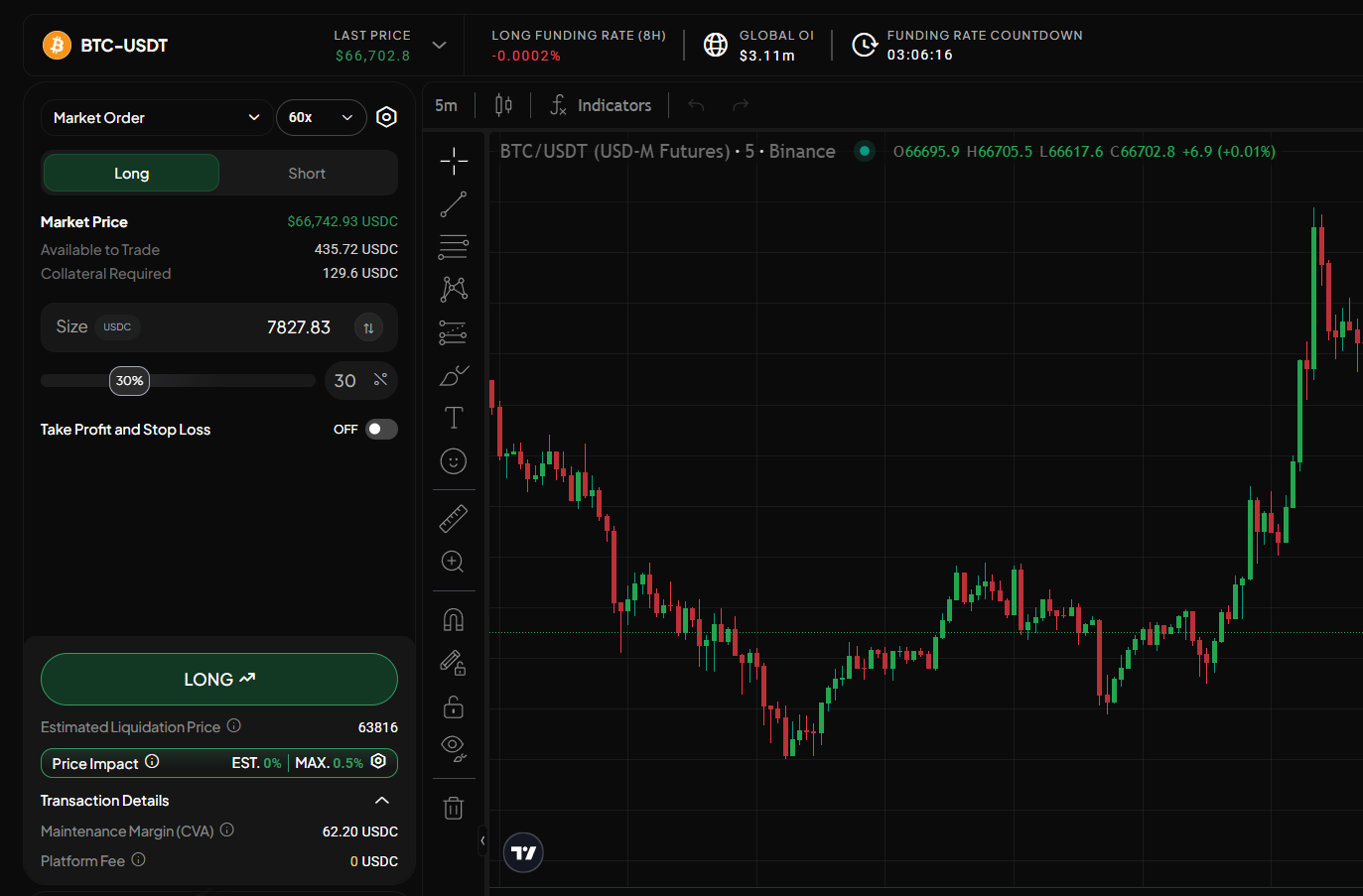
Go to the **Trading page**, choose a pair (e.g. BTC/USDT), set your position details:

* Direction (Long or Short)
* Size
* Leverage (up to 75x)
* Optional: Stop Loss / Take Profit

Click **“Long/Short”** to execute instantly.

<figure><img src="https://3351097766-files.gitbook.io/~/files/v0/b/gitbook-x-prod.appspot.com/o/spaces%2FbpemdioXs8P0YBsLx7uh%2Fuploads%2FwlioFas9hJV6u04YXfKS%2Fimage.png?alt=media&amp;token=840255d0-13c5-4627-ab17-5d2b51429991" alt=""><figcaption></figcaption></figure>

***

#### <mark style="color:$info;">**5. Track Your Position**</mark>

All active trades appear under the **“Positions”** tab.\
Here you can:

* Monitor PnL
* Close positions
* Edit SL/TP
* Edit Size
* View the estimated liquidation price

<figure><img src="https://3351097766-files.gitbook.io/~/files/v0/b/gitbook-x-prod.appspot.com/o/spaces%2FbpemdioXs8P0YBsLx7uh%2Fuploads%2FmAXLSYh9YSlscrrCQzAY%2Fimage.png?alt=media&amp;token=98f786f2-d2b2-4ea0-aa85-c6c84e2f243c" alt=""><figcaption></figcaption></figure>

***

That’s it — you're live.\
Now start trading, climb the leaderboard, and stack profit.

**📍 Need help?** Jump in [Discord](https://discord.gg/CarbonTerminal)


# Trading Basics

### <mark style="color:$info;">**On-Chain Perpetual Futures**</mark>

When you trade on Carbon, you’re entering on-chain perpetual futures contracts, derivative contracts with no expiry. Instead of settling at a fixed date, these contracts allow traders to take long or short positions on an asset’s price for as long as they choose.

Closing a position results in a cash settlement based on the price difference from entry to exit, with leverage amplifying the potential profit or loss. Since these contracts remain open indefinitely, traders should monitor funding rates and market conditions to manage risk effectively.

### <mark style="color:$info;">Collateral & Cross-Margin Accounts</mark>

Before trading, users deposit USDC as collateral into a cross-margin account. Instead of managing margin separately for each position, this account pools all positions together, allowing profits and losses to offset each other and improving capital efficiency.

* **More liquidity, fewer liquidations:** Cross-margining reduces unnecessary liquidations by using collateral from all open positions.
* **Increased flexibility:** Margin can be utilized across all trades within the same account.
* **Risk management**: While cross-margining helps protect positions, traders must monitor leverage, as rapid market changes can lead to losses exceeding initial collateral.

In a future update, traders can use isolated margin to manage individual positions separately. Until then, traders can isolate positions by using sub-accounts.

### <mark style="color:$info;">Funding Rates</mark>

Perpetual futures don’t expire, so Carbon uses a funding rate mechanism to keep contract prices in line with the spot market.

* Positive funding rate → Longs pay shorts.
* Negative funding rate → Shorts pay longs.

Funding rates are exchanged between traders holding positions, ensuring the perpetual contract price stays close to the real market price.

**Funding Rates are carbon are displayed based on your direction. Clicking Long shows you the long funding rate (positive means you get paid, negative means you have to pay) and vice versa.**

### <mark style="color:$info;">Platform Fees</mark>

{% hint style="info" %}
**Currently, Carbon charges zero fees on all pairs.**
{% endhint %}

## <mark style="color:$info;">Key Trading Metrics & Risk Management</mark>

### <mark style="color:$info;">**Unrealized Profit & Loss (UPNL)**</mark>

Shows potential gains or losses if a position were closed at the current market price.

* Dynamic Evaluation: UPNL is calculated dynamically, reflecting the potential gains or losses a trader would incur if they decide to close their active positions at the prevailing market price.
* Formula: UPNL is computed by evaluating the difference between the average entry price of a position and the current index price, expressed in USD terms.&#x20;
* Continuous Update: The UPNL value is continuously updated to provide traders with the most accurate representation of their trading performance as market conditions change.

📌**Formula:**

```
UPNL = (Mark Price - Entry Price) * Position Size
```

### <mark style="color:$info;">**Open Interest (OI)**</mark>

Represents the total value of active perpetual contracts. If current OI reaches available OI, no new positions can be opened until existing ones close.

### <mark style="color:$info;">**Account Health**</mark>

Indicates the health of a trader's position. If the Equity Balance drops to the Maintenance Margin, the position risks liquidation.

📌**Formula:**

```
Account Health = (Equity Balance - Maintenance Margin) / Equity Balance
```

### <mark style="color:$info;">**Maintenance Margin**</mark>

The minimum balance required to keep a position open. If the Equity Balance falls to this level, liquidation occurs. This margin is locked and non-transferable, encompassing all open positions.

### <mark style="color:$info;">**Equity Balance**</mark>

A combination of account balance and UPNL, showing the trader’s real-time funds.

📌**Formula**:

```
Equity Balance = Allocated Balance + UPNL
```

### <mark style="color:$info;">**Initial & Locked Margin**</mark>

* Initial Margin → The required margin to open a position.
* Locked Margin → The portion of margin locked across open trades, acting as a buffer to prevent excessive leverage.

### <mark style="color:$info;">**Available for Orders**</mark>

The remaining balance is available for placing new trades.

📌**Formula:**

```
Available for Orders = Equity Balance - Locked Margin - Maintenance Margin
```

## <mark style="color:$info;">Withdrawals & Fraud-Proof Window</mark>

To maintain on-chain security, withdrawals undergo a fraud-proof verification period before processing. This mechanism helps prevent issues like double-spending. Future integrations may provide faster withdrawal solutions. Currently, instant withdrawal is available for up to $1,000.

<br>


# Liquidations, CVA, and Account Health

### <mark style="color:$info;">Liquidations on Carbon</mark>

A liquidation occurs when a trader’s Equity Balance falls below the Maintenance Margin (CVA) due to unrealized losses. When this happens, all open positions are forcibly closed, and the trader loses the locked margin.

{% hint style="info" %}
🚨 Warning: Carbon uses a cross-margin system, meaning the entire account balance is at risk of liquidation. To better manage risk, traders can use subaccounts to isolate positions.
{% endhint %}

***

### <mark style="color:$info;">Managing Liquidation Risk</mark>

#### **Estimated Liquidation Prices**

Carbon provides estimated liquidation prices for open positions, but actual values fluctuate based on account balance and market conditions. Traders can view:

* Pre-trade estimates in the trade details window.
* Live estimates in the Positions tab.

<figure><img src="https://3351097766-files.gitbook.io/~/files/v0/b/gitbook-x-prod.appspot.com/o/spaces%2FbpemdioXs8P0YBsLx7uh%2Fuploads%2Fu21uKIzwUmAJHQDf5ie4%2Fimage.png?alt=media&amp;token=e190e128-98f8-4096-ac2a-775f6e6898f6" alt=""><figcaption></figcaption></figure>

{% hint style="info" %}
⚠️ Cross-margin accounts do not have a fixed liquidation price. Instead, traders should monitor their Remaining Equity to Liquidation to avoid being liquidated unexpectedly.
{% endhint %}

***

### <mark style="color:$info;">Key Metrics to Monitor</mark>

#### **Account Health (%)**

Represents the overall risk level of your account. When Account Health drops to zero, liquidation occurs.

📌 Formula:

```
(Equity Balance - Maintenance Margin) / (Allocated Balance - Maintenance Margin)
```

#### <mark style="color:$info;">**Maintenance Margin (CVA)**</mark>

The minimum collateral required to keep positions open. If Equity Balance falls below CVA, liquidation occurs.

* Higher leverage = higher CVA requirement.
* CVA is locked when opening a trade and is lost upon liquidation.

📌 Formula: Displayed in the Account Overview tab.

#### <mark style="color:$info;">**Equity Balance**</mark>

The total account balance, including all open positions and unrealized P\&L.

📌 Formula:

```
Allocated Balance + Unrealized PNL
```

🚨 If Equity Balance < CVA, liquidation occurs.

#### <mark style="color:$info;">**Remaining Equity to Liquidation**</mark>

The amount of equity left before liquidation. When this reaches zero, the entire account is liquidated.

📌 Formula:

```
Equity Balance - Maintenance Margin (CVA)
```

#### <mark style="color:$info;">**Available for Orders**</mark>

The remaining funds available for placing new trades.

📌 Formula:

```
Equity Balance - Locked Margin - Maintenance Margin
```

<figure><img src="https://3351097766-files.gitbook.io/~/files/v0/b/gitbook-x-prod.appspot.com/o/spaces%2FbpemdioXs8P0YBsLx7uh%2Fuploads%2FvXOvvPN1eAb5ykxIuDgs%2Fimage.png?alt=media&amp;token=fde30740-9b2e-4410-9e1e-84b0d4c10c8f" alt=""><figcaption></figcaption></figure>

***

### <mark style="color:$info;">Stay in Control</mark>

Keeping an eye on Account Health, Maintenance Margin, and Remaining Equity to Liquidation is critical for managing risk on Carbon.&#x20;

<br>


# Understanding Funding Rates

### <mark style="color:$info;">Introduction</mark>

Funding rates are crucial components in the trading of perpetual contracts on Carbon. These are periodic payments exchanged between traders and solvers who hold positions in perpetual contracts. The funding rate mechanism ensures that the price of the perpetual contract remains close to the underlying asset's spot price.

***

### <mark style="color:$info;">How Funding Works on Carbon</mark>

Funding rates are small payments exchanged between traders and solvers based on whether long or short positions are dominant.

* **Positive Funding**: When the perp price is above spot, **longs pay shorts**. This discourages excessive long positioning and brings prices back in line.
* **Negative Funding**: When the perp price is below spot, **shorts pay longs**. This disincentivizes overly bearish pressure and helps restore equilibrium.

Carbon doesn’t use a fixed oracle or index price. Instead, the protocol uses pricing streamed by solvers, who in turn pull data from CEXs, DEXs, and other sources,  to determine the fair value of each asset and calculate the funding rate accordingly.\
\
**Funding Rates on carbon are displayed based on your direction. Clicking Long shows you the long funding rate (positive means you get paid, negative means you have to pay) and vice versa.**

***

### <mark style="color:$info;">Solver-Based Funding</mark>

Carbon’s pricing engine is solver-driven. Solvers are market participants that stream executable quotes based on off-chain hedging venues. These quotes aren’t just for trading, they also anchor the funding rate.

This has two benefits:

1. **No Oracle Dependence** – Pricing stays responsive to real market conditions.
2. **Market-Driven Adjustments** – Funding dynamically shifts based on where solvers and traders are leaning.

> **Note:** If the calculated funding amount is smaller than the gas cost to settle it, the fee will be skipped. This avoids unnecessary on-chain transactions and preserves capital.

***

### <mark style="color:$info;">What This Means for Traders</mark>

Funding rates affect the cost of holding a position. If you’re paying funding, it eats into your PnL. If you’re earning it, it can boost your gains; even in a sideways market.

That means:

* **Timing matters** – Avoid paying excessive funding by understanding positioning skew.
* **Strategy matters** – Some traders use funding rates to build directional or neutral strategies.
* **Execution matters** – Because Carbon has no funding fee markup or platform take, all funding flows directly between traders and solvers.

***

### <mark style="color:$info;">Summary</mark>

Funding on Carbon is simple, clean, and solver-powered. It’s designed to:

* Keep perps aligned with real market prices
* Incentivize balanced positioning
* Avoid reliance on centralized oracles
* Let traders build smarter, more adaptive strategies

#### &#x20; <a href="#how-funding-rates-work" id="how-funding-rates-work"></a>


# Take Profit & Stop Loss

Carbon offers instant execution for Stop Loss (SL) and Take Profit (TP) orders, ensuring traders can secure profits or limit losses without delays. Once triggered, the order is executed immediately at market price.

***

### <mark style="color:$info;">How SL & TP Work</mark>

1. **Price Hits Target**

* Take Profit (TP) → If the market price ≥ TP, the position closes instantly.
* Stop Loss (SL) → If the market price ≤ SL, the position closes instantly.

2. **Reliable Pricing Mechanism**

* Prices are sourced from Binance price feeds, Last Price, and Mark Price with fallback protections to prevent manipulation.
* Default Trigger: Uses Last Price (99% of the time).
* Volatility Protection: If Last Price deviates >0.25% from Mark Price, the system switches to Mark Price to prevent bad fills.

3. **Instant Execution at Market Price**

* SL/TP orders execute immediately once triggered—no delays, no waiting.
* Orders fill at market price, which may differ slightly from the trigger price due to market movement.

4. **Gasless Transactions**

* Carbon covers gas fees, making SL/TP execution free for users.

{% hint style="info" %}
Warning: As a front-end implemented solution, Carbon cannot guarantee that the close order is complete on the solver side, only that the close request is sent correctly to the solver. This dependency exists on the SYMMIO and solver side, with further development required to create a 100% robust system, including a multi-dimensional system with redundancies on both the Carbon and solver side.
{% endhint %}

<figure><img src="https://3351097766-files.gitbook.io/~/files/v0/b/gitbook-x-prod.appspot.com/o/spaces%2FbpemdioXs8P0YBsLx7uh%2Fuploads%2Fd3zRQUHfTekuzkRn6d7Y%2Fimage.png?alt=media&amp;token=defe0bf5-6713-49c5-9245-bf4a40e950be" alt=""><figcaption></figcaption></figure>

**🚨 Important Note: Carbon ensures the order is executed instantly, but final execution depends on liquidity availability at the time of the trigger.**


# Pricing Data & Oracles

**Carbon uses a competitive Solver network to deliver accurate, real-time pricing, sourced from across the market, not a single feed.**

Unlike traditional exchanges that rely on one pricing source, Solvers on Carbon pull data from multiple places: CEXs, DEXs, and OTC venues, to offer the most competitive quotes and best execution.

***

### <mark style="color:$info;">How Carbon Gets Pricing Data</mark>

* **Solver-Driven Quotes**\
  Solvers continuously stream quotes to Carbon, sourcing pricing from multiple venues to reflect real market conditions.
* **Competitive Accuracy**\
  Solvers compete to offer the best quotes, creating a pricing environment driven by market efficiency, not manipulation.

### <mark style="color:$info;">The Role of Oracles</mark>

* **Dispute Resolution**\
  Oracles step in only when needed, to resolve price disputes or edge cases where pricing deviation occurs.
* **Liquidation Triggers & Risk Monitoring**\
  Oracles evaluate account health and collateral. If margin requirements aren’t met, liquidation is triggered via a neutral third party.

### <mark style="color:$info;">Why This Matters</mark>

* **Accurate Pricing**\
  Solver competition ensures you always get the most reliable quotes.
* **Fair Liquidation Process**\
  Oracles act independently, protecting traders from unfair liquidations.
* **Fast & Efficient Execution**\
  Solver-sourced quotes mean low slippage, minimal latency, and better trade outcomes.


# Open Interest

Open Interest (OI) is one of the key metrics used on Carbon to understand platform liquidity, available capacity, and trading demand. It reflects the real-time health of the trading system, how much capital is currently active, and how much is still available to power new trades.

***

### <mark style="color:$info;">What is Open Interest?</mark>

**Definition**\
Open Interest (OI) on Carbon represents the total value of live perpetual contracts that are currently open and unsettled. It shows the amount of notional exposure that the Carbon Solver network is actively supporting at any given time.

**How It’s Calculated**\
OI is determined by the collateral solvers have deployed on-chain to facilitate trading. Each solver has its own OI cap, depending on how much liquidity solvers have provisioned. With the Carbon Solver (CLP), OI is set to increase tremendously.

We use the following formula:

**OI Ratio = Current OI / Available OI**

As this ratio increases, it signals greater trading activity; but also less headroom for new positions unless additional solver capital is allocated or existing trades are closed.

***

### <mark style="color:$info;">Key Characteristics of Carbon’s OI Model</mark>

* **Chain-Specific**: OI is tracked separately per chain. Solvers allocate collateral where trading demand is highest.
* **Dynamic & Uncapped**: There are no hard-coded limits set by the protocol. All limits are dynamic and based on real liquidity from solvers.
* **Market-Responsive**: As OI fills up, new trading may temporarily slow down, encouraging natural rebalancing or new solver capital to enter.

***

### <mark style="color:$info;">Why OI Matters</mark>

**1. Liquidity Signal**\
Higher OI means more active contracts and deeper liquidity. It’s a live reflection of how much the system is being used.

**2. Sentiment Gauge**\
Rising OI often means new money is flowing in, a sign of growing interest or trend conviction. Falling OI might suggest profit-taking or risk-off behavior.

**3. Execution Impact**\
When OI is nearing capacity, traders may see fewer quotes or temporarily limited sizing. Monitoring the OI ratio helps traders plan entries and exits more effectively.

***

### <mark style="color:$info;">Example Scenarios</mark>

**Example 1: High OI Indicates Market Momentum**\
A trader sees OI rapidly increasing on BTC/USDC. This could signal strong inflows and growing trend conviction. They decide to long BTC with confidence the market has volume behind it.

**Example 2: Declining OI Suggests Caution**\
A trader notices that ETH/USDC OI has been dropping for several days. Fewer open positions may point to cooling interest or profit-taking. The trader tightens stops and reduces exposure.

**Example 3: OI and Volume Divergence**\
LTC/USDC OI is still rising, but daily trading volume is flat or dropping. This divergence suggests traders are holding positions but not entering aggressively. The trader decides to wait for a breakout before taking a position.

> These examples are for educational purposes only. None of this is financial advice.

***

### <mark style="color:$info;">Strategy & Risk Management Tips</mark>

* **Monitor OI Ratio**: A high ratio means the system is heavily utilized. Consider how that may affect execution.
* **Understand Collateral Dynamics**: OI is collateral-backed. Solvers must be capitalized on each chain, if demand spikes, additional liquidity may take time to arrive.
* **Anticipate Congestion**: If OI nears capacity, opening new large positions may become harder. Use this knowledge when managing entries, exits, or scaling into trades.

***

### <mark style="color:$info;">In Summary</mark>

Carbon's Open Interest model is designed to reflect real-time trading activity and capacity. Because liquidity is sourced from live solver collateral, OI isn't just a number, it’s a real signal of how much firepower the system currently has.

**Watch the OI ratio.** Trade accordingly.

And remember: the more active the Carbon ecosystem becomes, the deeper and more liquid the system gets.


# Fee Rebates

Carbon offers a dynamic fee rebate program that rewards traders based on their trading volume and rank. The higher your volume and rank, the larger your rebate, up to 60% back on your trading fees.

#### <mark style="color:$info;">How Fee Rebates Work</mark>

* Rebates are calculated on a rolling 30-day trading volume.
* Rebates apply to your **net fees paid**.
* Rebates can be claimed directly from the **Rewards page**.
* Your current rebate tier is always visible in your **Account** section, with a shortcut to claim at any time.

***

### <mark style="color:$info;">Rebate Tiers</mark>

Below is the rebate table based on your monthly trading volume and rank:

| 30d Volume | No Rank | Iron | Silver | Gold | Diamond | Carbon |
| ---------- | ------- | ---- | ------ | ---- | ------- | ------ |
| 10M        | 0%      | 4%   | 8%     | 12%  | 15%     | 25%    |
| 25M        | 4%      | 6%   | 10%    | 15%  | 25%     | 35%    |
| 100M       | 6%      | 8%   | 15%    | 22%  | 35%     | 42%    |
| 250M       | 8%      | 12%  | 20%    | 28%  | 42%     | 50%    |
| 500M+      | 10%     | 15%  | 25%    | 35%  | 50%     | 60%    |

<figure><img src="https://3351097766-files.gitbook.io/~/files/v0/b/gitbook-x-prod.appspot.com/o/spaces%2FbpemdioXs8P0YBsLx7uh%2Fuploads%2FYxfp79exsRgvWRfLhOR1%2Fimage.png?alt=media&amp;token=3ce3443a-1bb1-4396-a266-6ddff5564519" alt=""><figcaption></figcaption></figure>

***

### <mark style="color:$info;">Example Calculation</mark>

Suppose you have:

* 30-day volume: 250M
* Rank: Diamond

1. **Personal rebate:** 42%\
   For a $100 fee, you pay $58 net.
2. You can now claim $42 in fees from your rewards section.

***

### <mark style="color:$info;">How to Claim</mark>

1. Go to your [**Account**](https://app.carbon.inc/account/overview) to check your current tier.
2. Click **Claim Rebates.**&#x20;
3. Confirm and claim directly from the smart contract.

***

### <mark style="color:$info;">Notes</mark>

* Rebates are updated continuously based on your last 30 days of trading.
* Claiming requires a transaction to the on-chain contract.


# Security & Withdrawals

**Carbon is committed to secure and transparent withdrawals. Here's how the process works and the safeguards in place to protect your funds.**

**Users can enable Instant Withdrawals, however please note that your requested amount might be too much for an instant withdrawal. If instant withdrawal isn't possible, although it most likely is, withdrawals will work as follows:**

***

### <mark style="color:$info;">Withdrawal Process</mark>

* **Request Initiation**\
  Submit a withdrawal via the Manage Account page. The request is acknowledged instantly, and security checks begin.
* **12-Hour Fraud-Proof Window**\
  A 12-hour verification period begins once a request is made. This protects against double-spending or malicious behavior by allowing time for validation.
* **Multiple Requests**\
  If another withdrawal is submitted during an active window, the timer resets, the 12 hours start over.
* **Cancel Anytime**\
  You can cancel your withdrawal request anytime during the 12-hour window. Your funds are immediately reallocated back to your trading account.
* **Approval & Release**\
  After the fraud-proof window ends and the request is verified, funds are released securely to your destination address.
* **Future Upgrades**\
  Carbon plans to integrate third-party verification services to make this process instant while keeping it safe and trustless.

## <mark style="color:$info;">Security Measures</mark>

* Two-Factor Authentication (2FA)\
  Enable 2FA to secure your account. This adds a second layer of protection and reduces the risk of unauthorized access.
* End-to-End Encryption\
  All sensitive data is encrypted during transmission, ensuring your information stays protected at every step.
* Smart Contract Audits\
  Carbon’s infrastructure will undergo routine audits to identify and fix potential vulnerabilities, keeping your assets secure and the system reliable.

**Your funds stay protected. Your withdrawals stay trustless.**

<br>


# Referrals

Bring new traders to Carbon and earn rewards automatically.

***

### <mark style="color:$info;">How It Works</mark>

* **Referrers** earn 20% of the points that their referred users generate.
* **Referees** get a 10% bonus on the points they earn.

### <mark style="color:$info;">Ways to Trigger a Referral</mark>

* **Invite Someone Directly**
  * Share your referral code or link. If they join through it, they’re tagged as your referral.

### <mark style="color:$info;">Referral Priority Rules</mark>

* If a user is already referred through a referral code or link, that connection remains permanent.

### <mark style="color:$info;">Where to Find Your Referral Code</mark>

* Your Refferal Code can be found by click [here](https://app.carbon.inc/account/referrals).

**More traders, more points, more rewards. Simple.**

<br>


# Pair List

Carbon allows for the widest range of assets tradable anywhere on-chain. Below is a list of the Trading Pairs at current times with their associated max leverage:

<table><thead><tr><th width="146">Pair ID (#)</th><th width="302">Asset Name</th><th width="157">Pair Ticker</th><th>Leverage</th></tr></thead><tbody><tr><td>1</td><td>Bitcoin</td><td>BTC / USDT</td><td>60x</td></tr><tr><td>2</td><td>Ethereum</td><td>ETH / USDT</td><td>60x</td></tr><tr><td>3</td><td>BNB</td><td>BNB / USDT</td><td>50x</td></tr><tr><td>4</td><td>Solana</td><td>SOL / USDT</td><td>40x</td></tr><tr><td>5</td><td>USDC</td><td>USDC / USDT</td><td>40x</td></tr><tr><td>6</td><td>Ripple</td><td>XRP / USDT</td><td>50x</td></tr><tr><td>7</td><td>Dogecoin</td><td>DOGE / USDT</td><td>60x</td></tr><tr><td>8</td><td>Toncoin</td><td>TON / USDT</td><td>25x</td></tr><tr><td>9</td><td>Tron</td><td>TRON / USDT</td><td>40x</td></tr><tr><td>10</td><td>Cardano</td><td>ADA / USDT</td><td>50x</td></tr><tr><td>11</td><td>Avalanche</td><td>AVAX / USDT</td><td>40x</td></tr><tr><td>12</td><td>Shiba Inu</td><td>1000SHIB / USDT</td><td>40x</td></tr><tr><td>13</td><td>Chainlink</td><td>LINK / USDT</td><td>50x</td></tr><tr><td>14</td><td>Bitcoin Cash</td><td>BCH / USDT</td><td>50x</td></tr><tr><td>15</td><td>Polkadot</td><td>DOT / USDT</td><td>40x</td></tr><tr><td>16</td><td>Litecoin</td><td>LTC / USDT</td><td>50x</td></tr><tr><td>17</td><td>Kaspa</td><td>KAS / USDT</td><td>20x</td></tr><tr><td>18</td><td>Uniswap</td><td>UNI / USDT</td><td>40x</td></tr><tr><td>19</td><td>Internet Computer</td><td>ICP / USDT</td><td>25x</td></tr><tr><td>20</td><td>Artificial Superintelligence Alliance</td><td>FET / USDT</td><td>25x</td></tr><tr><td>21</td><td>Monero</td><td>XMR / USDT</td><td>25x</td></tr><tr><td>22</td><td>Sui</td><td>SUI / USDT</td><td>40x</td></tr><tr><td>23</td><td>Pepe</td><td>1000PEPE / USDT</td><td>40x</td></tr><tr><td>24</td><td>Aptos</td><td>APT / USDT</td><td>40x</td></tr><tr><td>25</td><td>Stellar</td><td>XLM / USDT</td><td>25x</td></tr><tr><td>26</td><td>POL</td><td>POL / USDT</td><td>25x</td></tr><tr><td>27</td><td>Ethereum Classic</td><td>ETC / USDT</td><td>50x</td></tr><tr><td>28</td><td>TAO</td><td>TAO / USDT</td><td>25x</td></tr><tr><td>29</td><td>Stacks</td><td>STX / USDT</td><td>25x</td></tr><tr><td>30</td><td>Immutable</td><td>IMX / USDT</td><td>25x</td></tr><tr><td>31</td><td>Aave</td><td>AAVE / USDT</td><td>25x</td></tr><tr><td>32</td><td>Filecoin</td><td>FIL / USDT</td><td>40x</td></tr><tr><td>33</td><td>Injective</td><td>INJ / USDT</td><td>25x</td></tr><tr><td>34</td><td>Arbitrum</td><td>ARB / USDT</td><td>40x</td></tr><tr><td>35</td><td>Render</td><td>RENDER / USDT</td><td>25x</td></tr><tr><td>36</td><td>Hedera</td><td>HBAR / USDT</td><td>25x</td></tr><tr><td>37</td><td>Optimism</td><td>OP / USDT</td><td>40x</td></tr><tr><td>38</td><td>Vechain</td><td>VET / USDT</td><td>40x</td></tr><tr><td>39</td><td>Cosmos</td><td>ATOM / USDT</td><td>40x</td></tr><tr><td>40</td><td>Fantom</td><td>FTM / USDT</td><td>40x</td></tr><tr><td>41</td><td>dogwifhat</td><td>WIF / USDT</td><td>40x</td></tr><tr><td>42</td><td>THORchain</td><td>RUNE / USDT</td><td>25x</td></tr><tr><td>43</td><td>The Graph</td><td>GRT / USDT</td><td>25x</td></tr><tr><td>44</td><td>Arweave</td><td>AR / USDT</td><td>20x</td></tr><tr><td>45</td><td>Floki</td><td>1000FLOKI / USDT</td><td>40x</td></tr><tr><td>46</td><td>Bonk</td><td>1000BONK / USDT</td><td>40x</td></tr><tr><td>47</td><td>Celestia</td><td>TIA / USDT</td><td>20x</td></tr><tr><td>48</td><td>Pyth Network</td><td>PYTH / USDT</td><td>40x</td></tr><tr><td>49</td><td>Algorand</td><td>ALGO / USDT</td><td>20x</td></tr><tr><td>50</td><td>Jupiter</td><td>JUP / USDT</td><td>25x</td></tr><tr><td>51</td><td>Sei</td><td>SEI / USDT</td><td>40x</td></tr><tr><td>52</td><td>JasmyCoin</td><td>JASMY / USDT</td><td>20x</td></tr><tr><td>53</td><td>Bitcoin SV</td><td>BSV / USDT</td><td>25x</td></tr><tr><td>54</td><td>MANTRA</td><td>OM / USDT</td><td>25x</td></tr><tr><td>55</td><td>Lido DAO</td><td>LDO / USDT</td><td>40x</td></tr><tr><td>56</td><td>Quant</td><td>QNT / USDT</td><td>20x</td></tr><tr><td>57</td><td>Ondo</td><td>ONDO / USDT</td><td>25x</td></tr><tr><td>58</td><td>Flow</td><td>FLOW / USDT</td><td>20x</td></tr><tr><td>59</td><td>Nervos Network</td><td>CKB / USDT</td><td>20x</td></tr><tr><td>60</td><td>Notcoin</td><td>NOT / USDT</td><td>20x</td></tr><tr><td>61</td><td>Brett</td><td>BRETT / USDT</td><td>10x</td></tr><tr><td>62</td><td>Beam</td><td>BEAMX / USDT</td><td>40x</td></tr><tr><td>63</td><td>EOS</td><td>EOS / USDT</td><td>50x</td></tr><tr><td>64</td><td>MultiverseX</td><td>EGLD / USDT</td><td>25x</td></tr><tr><td>65</td><td>Axie Infinity</td><td>AXS / USDT</td><td>40x</td></tr><tr><td>66</td><td>Starknet</td><td>STRK / USDT</td><td>25x</td></tr><tr><td>67</td><td>Popcat</td><td>POPCAT / USDT</td><td>40x</td></tr><tr><td>68</td><td>Worldcoin</td><td>WLD / USDT</td><td>15x</td></tr><tr><td>69</td><td>NEO</td><td>NEO / USDT</td><td>40x</td></tr><tr><td>70</td><td>ORDI</td><td>ORDI / USDT</td><td>20x</td></tr><tr><td>71</td><td>GALA</td><td>GALA / USDT</td><td>40x</td></tr><tr><td>72</td><td>Tezos</td><td>XTZ / USDT</td><td>20x</td></tr><tr><td>73</td><td>Conflux</td><td>CFX / USDT</td><td>40x</td></tr><tr><td>74</td><td>eCash</td><td>1000XEC / USDT</td><td>20x</td></tr><tr><td>75</td><td>BinaryX</td><td>BNX / USDT</td><td>10x</td></tr><tr><td>76</td><td>The Sandbox</td><td>SAND / USDT</td><td>40x</td></tr><tr><td>77</td><td>Ethereum Name Service</td><td>ENS / USDT</td><td>20x</td></tr><tr><td>78</td><td>Wormhole</td><td>W / USDT</td><td>20x</td></tr><tr><td>79</td><td>Decentraland</td><td>MANA / USDT</td><td>40x</td></tr><tr><td>80</td><td>Pendle</td><td>PENDLE / USDT</td><td>20x</td></tr><tr><td>81</td><td>Ronin</td><td>RONIN / USDT</td><td>25x</td></tr><tr><td>82</td><td>Klaytn</td><td>KLAY / USDT</td><td>25x</td></tr><tr><td>83</td><td>Dogs</td><td>DOGS / USDT</td><td>25x</td></tr><tr><td>84</td><td>Mina Protocol</td><td>MINA / USDT</td><td>25x</td></tr><tr><td>85</td><td>Zcash</td><td>ZEC / USDT</td><td>25x</td></tr><tr><td>86</td><td>Chiliz</td><td>CHZ / USDT</td><td>25x</td></tr><tr><td>87</td><td>Luna Classic</td><td>1000LUNC / USDT</td><td>25x</td></tr><tr><td>88</td><td>PancakeSwap</td><td>CAKE / USDT</td><td>25x</td></tr><tr><td>89</td><td>Synthetix</td><td>SNX / USDT</td><td>25x</td></tr><tr><td>90</td><td>ApeCoin</td><td>APE / USDT</td><td>40x</td></tr><tr><td>91</td><td>Astar</td><td>ASTR / USDT</td><td>20x</td></tr><tr><td>92</td><td>LayerZero</td><td>ZRO / USDT</td><td>20x</td></tr><tr><td>93</td><td>Livepeer</td><td>LPT / USDT</td><td>25x</td></tr><tr><td>94</td><td>Ethena</td><td>ENA / USDT</td><td>10x</td></tr><tr><td>95</td><td>Oasis Network</td><td>ROSE / USDT</td><td>25x</td></tr><tr><td>96</td><td>BOOK OF MEME</td><td>BOME / USDT</td><td>25x</td></tr><tr><td>97</td><td>IOTA</td><td>IOTA / USDT</td><td>25x</td></tr><tr><td>98</td><td>ZkSync</td><td>ZK / USDT</td><td>20x</td></tr><tr><td>99</td><td>SuperVerse</td><td>SUPER / USDT</td><td>25x</td></tr><tr><td>100</td><td>Axelar</td><td>AXL / USDT</td><td>25x</td></tr><tr><td>101</td><td>cat in a dogs world</td><td>MEW / USDT</td><td>25x</td></tr><tr><td>102</td><td>Compound</td><td>COMP / USDT</td><td>25x</td></tr><tr><td>103</td><td>SafePal</td><td>SFP / USDT</td><td>25x</td></tr><tr><td>104</td><td>Trust Wallet</td><td>TWT / USDT</td><td>25x</td></tr><tr><td>105</td><td>Neiro</td><td>NEIRO / USDT</td><td>25x</td></tr><tr><td>106</td><td>Turbo</td><td>TURBO / USDT</td><td>25x</td></tr><tr><td>107</td><td>Dymension</td><td>DYM / USDT</td><td>25x</td></tr><tr><td>108</td><td>Kava</td><td>KAVA / USDT</td><td>25x</td></tr><tr><td>109</td><td>Blur</td><td>BLUR / USDT</td><td>25x</td></tr><tr><td>110</td><td>Curve DAO</td><td>CRV / USDT</td><td>25x</td></tr><tr><td>111</td><td>Aevo</td><td>AEVO / USDT</td><td>25x</td></tr><tr><td>112</td><td>IoTex</td><td>IOTX / USDT</td><td>20x</td></tr><tr><td>113</td><td>Reserve Rights</td><td>RSR / USDT</td><td>25x</td></tr><tr><td>114</td><td>Kusama</td><td>KSM / USDT</td><td>25x</td></tr><tr><td>115</td><td>GMT</td><td>GMT / USDT</td><td>25x</td></tr><tr><td>116</td><td>1Inch</td><td>1INCH / USDT</td><td>25x</td></tr><tr><td>117</td><td>WOO</td><td>WOO / USDT</td><td>20x</td></tr><tr><td>118</td><td>ConstitutionDAO</td><td>PEOPLE / USDT</td><td>25x</td></tr><tr><td>119</td><td>Dash</td><td>DASH / USDT</td><td>25x</td></tr><tr><td>120</td><td>Holo</td><td>HOT / USDT</td><td>25x</td></tr><tr><td>121</td><td>Golem</td><td>GLM / USDT</td><td>25x</td></tr><tr><td>122</td><td>Manta Network</td><td>MANTA / USDT</td><td>25x</td></tr><tr><td>123</td><td>Memecoin</td><td>MEME / USDT</td><td>40x</td></tr><tr><td>124</td><td>Basic Attention Token</td><td>BAT / USDT</td><td>20x</td></tr><tr><td>125</td><td>Terra</td><td>LUNA2 / USDT</td><td>8x</td></tr><tr><td>126</td><td>Jito</td><td>JTO / USDT</td><td>40x</td></tr><tr><td>127</td><td>Gravity</td><td>G / USDT</td><td>20x</td></tr><tr><td>128</td><td>RATS</td><td>1000RATS / USDT</td><td>25x</td></tr><tr><td>129</td><td>Zilliqa</td><td>ZIL / USDT</td><td>25x</td></tr><tr><td>130</td><td>Ankr Network</td><td>ANKR / USDT</td><td>25x</td></tr><tr><td>131</td><td>Celo</td><td>CELO / USDT</td><td>25x</td></tr><tr><td>132</td><td>0x Protocol</td><td>ZRX / USDT</td><td>25x</td></tr><tr><td>133</td><td>Enjin Coin</td><td>ENJ / USDT</td><td>40x</td></tr><tr><td>134</td><td>Ravencoin</td><td>RVN / USDT</td><td>20x</td></tr><tr><td>135</td><td>Qtum</td><td>QTUM / USDT</td><td>25x</td></tr><tr><td>136</td><td>Ether.fi</td><td>ETHFI / USDT</td><td>25x</td></tr><tr><td>137</td><td>Sun Token</td><td>SUN / USDT</td><td>20x</td></tr><tr><td>138</td><td>io.net</td><td>IO / USDT</td><td>20x</td></tr><tr><td>139</td><td>Space ID</td><td>ID / USDT</td><td>20x</td></tr><tr><td>140</td><td>SSV Network</td><td>SSV / USDT</td><td>20x</td></tr><tr><td>141</td><td>Arkham</td><td>ARKM / USDT</td><td>20x</td></tr><tr><td>142</td><td>ZetaChain</td><td>ZETA / USDT</td><td>25x</td></tr><tr><td>143</td><td>GMX</td><td>GMX / USDT</td><td>25x</td></tr><tr><td>144</td><td>Mask Network</td><td>MASK / USDT</td><td>40x</td></tr><tr><td>145</td><td>Threshold Network</td><td>T / USDT</td><td>20x</td></tr><tr><td>146</td><td>Gas</td><td>GAS / USDT</td><td>25x</td></tr><tr><td>147</td><td>Flux</td><td>FLUX / USDT</td><td>25x</td></tr><tr><td>148</td><td>Saga</td><td>SAGA / USDT</td><td>20x</td></tr><tr><td>149</td><td>Rocket Pool</td><td>RPL / USDT</td><td>25x</td></tr><tr><td>150</td><td>Polymesh</td><td>POLYX / USDT</td><td>25x</td></tr><tr><td>151</td><td>Open Campus</td><td>EDU / USDT</td><td>20x</td></tr><tr><td>152</td><td>DYDX</td><td>DYDX / USDT</td><td>40x</td></tr><tr><td>153</td><td>EthereumPoW</td><td>ETHW / USDT</td><td>25x</td></tr><tr><td>154</td><td>Metis</td><td>METIS / USDT</td><td>25x</td></tr><tr><td>155</td><td>Biconomy</td><td>BICO / USDT</td><td>10x</td></tr><tr><td>156</td><td>Big Time</td><td>BIGTIME / USDT</td><td>25x</td></tr><tr><td>157</td><td>Alt Layer</td><td>ALT / USDT</td><td>25x</td></tr><tr><td>158</td><td>Skale</td><td>SKL / USDT</td><td>20x</td></tr><tr><td>159</td><td>Illuvium</td><td>ILV / USDT</td><td>40x</td></tr><tr><td>160</td><td>COTI</td><td>COTI / USDT</td><td>25x</td></tr><tr><td>161</td><td>UMA</td><td>UMA / USDT</td><td>20x</td></tr><tr><td>162</td><td>Band Protocol</td><td>BAND / USDT</td><td>20x</td></tr><tr><td>163</td><td>Harmony</td><td>ONE / USDT</td><td>20x</td></tr><tr><td>164</td><td>yearn.finance</td><td>YFI / USDT</td><td>25x</td></tr><tr><td>165</td><td>Sushi</td><td>SUSHI / USDT</td><td>25x</td></tr><tr><td>166</td><td>NEM</td><td>XEM / USDT</td><td>25x</td></tr><tr><td>167</td><td>BounceBit</td><td>BB / USDT</td><td>25x</td></tr><tr><td>168</td><td>Chromia</td><td>CHR / USDT</td><td>25x</td></tr><tr><td>169</td><td>Loopring</td><td>LRC / USDT</td><td>20x</td></tr><tr><td>170</td><td>Tellor Tributes</td><td>TRB / USDT</td><td>40x</td></tr><tr><td>171</td><td>Yield Guild Games</td><td>YGG / USDT</td><td>25x</td></tr><tr><td>172</td><td>Ontology</td><td>ONT / USDT</td><td>25x</td></tr><tr><td>173</td><td>Vanar Chain</td><td>VANRY / USDT</td><td>20x</td></tr><tr><td>174</td><td>Magma Finance</td><td>MAGMA / USDT</td><td>20x</td></tr><tr><td>175</td><td>Alchemy Pay</td><td>ACH / USDT</td><td>20x</td></tr><tr><td>176</td><td>Storj</td><td> STORJ / USDT</td><td>15x</td></tr><tr><td>177</td><td>Pixels</td><td> PIXEL / USDT</td><td>25x</td></tr><tr><td>178</td><td>Banana Gun</td><td>BANANA / USDT</td><td>20x</td></tr><tr><td>179</td><td>API3</td><td>API3 / USDT</td><td>25x</td></tr><tr><td>180</td><td>ICON</td><td>ICX / USDT</td><td>20x</td></tr><tr><td>181</td><td>Cysic</td><td>CYS / USDT</td><td>15x</td></tr><tr><td>182</td><td>Xai</td><td>XAI / USDT</td><td>25x</td></tr><tr><td>183</td><td>Horizen</td><td>ZEN / USDT</td><td>20x</td></tr><tr><td>184</td><td>UXLINK</td><td>UXLINK / USDT</td><td>25x</td></tr><tr><td>185</td><td>Trader Joe</td><td>JOE / USDT</td><td>8x</td></tr><tr><td>186</td><td>Lisk</td><td>LSK / USDT</td><td>25x</td></tr><tr><td>187</td><td>TrueFi</td><td>TRU / USDT</td><td>20x</td></tr><tr><td>188</td><td>Venus</td><td>XVS / USDT</td><td>20x</td></tr><tr><td>189</td><td>Balancer</td><td>BAL / USDT</td><td>25x</td></tr><tr><td>190</td><td>WAX</td><td>WAXP / USDT</td><td>25x</td></tr><tr><td>191</td><td>Ontology Gas</td><td>ONG / USDT</td><td>25x</td></tr><tr><td>192</td><td>iExec RLC</td><td>RLC / USDT</td><td>25x</td></tr><tr><td>193</td><td>Numeraire</td><td>NMR / USDT</td><td>8x</td></tr><tr><td>194</td><td>Cartesi</td><td>CTSI / USDT</td><td>25x</td></tr><tr><td>195</td><td>Powerledger</td><td>POWR / USDT</td><td>25x</td></tr><tr><td>196</td><td>Neutron</td><td>NTRN / USDT</td><td>25x</td></tr><tr><td>197</td><td>IOST</td><td>IOST / USDT</td><td>25x</td></tr><tr><td>198</td><td>TerraClassicUSD</td><td>USTC / USDT</td><td>40x</td></tr><tr><td>199</td><td>Coin98</td><td>C98 / USDT</td><td>25x</td></tr><tr><td>200</td><td>Dusk</td><td>DUSK / USDT</td><td>25x</td></tr><tr><td>201</td><td>Magic</td><td>MAGIC / USDT</td><td>20x</td></tr><tr><td>202</td><td>SuperRare</td><td>RARE / USDT</td><td>20x</td></tr><tr><td>203</td><td>Mines of Dalarnia</td><td>DAR / USDT</td><td>25x</td></tr><tr><td>204</td><td>Bounce</td><td>AUCTION / USDT</td><td>25x</td></tr><tr><td>205</td><td>Highstreet</td><td>HIGH / USDT</td><td>25x</td></tr><tr><td>206</td><td>Cyber</td><td>CYBER / USDT</td><td>15x</td></tr><tr><td>207</td><td>RSK Infrastructure Framework</td><td>RIF / USDT</td><td>25x</td></tr><tr><td>208</td><td>Artificial Intelligence Integral</td><td>AI / USDT</td><td>25x</td></tr><tr><td>209</td><td>Moonriver</td><td>MOVR / USDT</td><td>25x</td></tr><tr><td>210</td><td>Celer Network</td><td>CELR / USDT</td><td>25x</td></tr><tr><td>211</td><td>Fusionist</td><td>ACE / USDT</td><td>25x</td></tr><tr><td>212</td><td>Synapse</td><td>SYN / USDT</td><td>20x</td></tr><tr><td>213</td><td>Radiant</td><td>RDNT / USDT</td><td>20x</td></tr><tr><td>214</td><td>Syscoin</td><td>SYS / USDT</td><td>10x</td></tr><tr><td>215</td><td>Kyber Network Crystal</td><td>KNC / USDT</td><td>25x</td></tr><tr><td>216</td><td>Steem</td><td>STEEM / USDT</td><td>25x</td></tr><tr><td>217</td><td>Spell</td><td>SPELL / USDT</td><td>20x</td></tr><tr><td>218</td><td>Portal</td><td>PORTAL / USDT</td><td>25x</td></tr><tr><td>219</td><td>Liquity</td><td>LQTY / USDT</td><td>20x</td></tr><tr><td>220</td><td>Maverick Protocol</td><td>MAV  / USDT</td><td>15x</td></tr><tr><td>221</td><td>Dent</td><td>DENT / USDT</td><td>25x</td></tr><tr><td>222</td><td>Hooked Protocol</td><td>HOOK / USDT</td><td>20x</td></tr><tr><td>223</td><td>DODO</td><td>DODOX / USDT</td><td>15x</td></tr><tr><td>224</td><td>Omni Network</td><td>OMNI / USDT</td><td>10x</td></tr><tr><td>225</td><td>Orbs</td><td>ORBS / USDT</td><td>25x</td></tr><tr><td>226</td><td>StormX</td><td>STMX / USDT</td><td>8x</td></tr><tr><td>227</td><td>Evaa Protocol</td><td>EVAA / USDT</td><td>20x</td></tr><tr><td>228</td><td>Orchid Protocol</td><td>OXT / USDT</td><td>15x</td></tr><tr><td>229</td><td>Adventure Gold</td><td>AGLD / USDT</td><td>20x</td></tr><tr><td>230</td><td>LeverFi</td><td>LEVER / USDT</td><td>20x</td></tr><tr><td>231</td><td>Pieverse</td><td>PIEVERSE / USDT</td><td>25x</td></tr><tr><td>232</td><td>My Neighbor Alice</td><td>ALICE / USDT</td><td>20x</td></tr><tr><td>233</td><td>Hashflow</td><td>HFT / USDT</td><td>20x</td></tr><tr><td>234</td><td>Lista DAO</td><td>LISTA / USDT</td><td>20x</td></tr><tr><td>235</td><td>Stargate Finance</td><td>STG / USDT</td><td>25x</td></tr><tr><td>236</td><td>Phoenix</td><td>PHB / USDT</td><td>20x</td></tr><tr><td>237</td><td>NFPrompt</td><td>NFP / USDT</td><td>25x</td></tr><tr><td>238</td><td>Metal</td><td>MTL / USDT</td><td>25x</td></tr><tr><td>239</td><td>ARPA</td><td>ARPA / USDT</td><td>20x</td></tr><tr><td>240</td><td>Verge</td><td>XVG / USDT</td><td>15x</td></tr><tr><td>241</td><td>Everlyn</td><td>LYN / USDT</td><td>25x</td></tr><tr><td>242</td><td>Bancor Network</td><td>BNT / USDT</td><td>25x</td></tr><tr><td>243</td><td>Loom Network</td><td>LOOM / USDT</td><td>15x</td></tr><tr><td>244</td><td>Renzo</td><td>REZ / USDT</td><td>10x</td></tr><tr><td>245</td><td>ARK</td><td>ARK / USDT</td><td>15x</td></tr><tr><td>246</td><td>Origin Token</td><td>OGN / USDT</td><td>20x</td></tr><tr><td>247</td><td>Badger</td><td>BADGER / USDT</td><td>25x</td></tr><tr><td>248</td><td>Mobox</td><td>MBOX / USDT</td><td>25x</td></tr><tr><td>249</td><td>Reef</td><td>REEF / USDT</td><td>20x</td></tr><tr><td>250</td><td>Bluzelle</td><td>BLZ / USDT</td><td>10x</td></tr><tr><td>251</td><td>zkPass</td><td>ZKP / USDT</td><td>25x</td></tr><tr><td>252</td><td>NKN</td><td>NKN / USDT</td><td>20x</td></tr><tr><td>253</td><td>Stella</td><td>ALPHA / USDT</td><td>25x</td></tr><tr><td>254</td><td>Gitcoin</td><td>GTC / USDT</td><td>20x</td></tr><tr><td>255</td><td>Heroes of Mavia</td><td>MAVIA / USDT</td><td>25x</td></tr><tr><td>256</td><td>Alien Worlds</td><td>TLM / USDT</td><td>10x</td></tr><tr><td>257</td><td>Automata</td><td>ATA / USDT</td><td>20x</td></tr><tr><td>258</td><td>Tensor</td><td>TNSR / USDT</td><td>20x</td></tr><tr><td>259</td><td>OMG Network</td><td>OMG / USDT</td><td>205x</td></tr><tr><td>260</td><td>Aergo</td><td>AERGO / USDT</td><td>25x</td></tr><tr><td>261</td><td>NULS</td><td>NULS / USDT</td><td>25x</td></tr><tr><td>262</td><td>Bella Protocol</td><td>BEL / USDT</td><td>25x</td></tr><tr><td>263</td><td>BOB</td><td>BOB / USDT</td><td>25x</td></tr><tr><td>264</td><td>Ren</td><td>REN / USDT</td><td>25x</td></tr><tr><td>265</td><td>HumidFi</td><td>HFI / USDT</td><td>25x</td></tr><tr><td>266</td><td>VIDT DAO</td><td>VIDT / USDT</td><td>25x</td></tr><tr><td>267</td><td>Litentry</td><td>LIT / USDT</td><td>20x</td></tr><tr><td>268</td><td>Biswap</td><td>BSW / USDT</td><td>25x</td></tr><tr><td>269</td><td>Sentient</td><td>SENT / USDT</td><td>8x</td></tr><tr><td>270</td><td>Brevis</td><td>BREV / USDT</td><td>10x</td></tr><tr><td>271</td><td>COMBO</td><td>COMBO / USDT</td><td>20x</td></tr><tr><td>272</td><td>SelfKey</td><td>KEY / USDT</td><td>20x</td></tr><tr><td>273</td><td>Tranchess</td><td>CHESS / USDT</td><td>25x</td></tr><tr><td>274</td><td>Linear</td><td>LINA / USDT</td><td>20x</td></tr><tr><td>275</td><td>Alpaca Finance</td><td>ALPACA / USDT</td><td>20x</td></tr><tr><td>276</td><td>AirDAO</td><td>AMB / USDT</td><td>8x</td></tr><tr><td>277</td><td>Safe</td><td>SAFE / USDT</td><td>20x</td></tr><tr><td>278</td><td>BarnBridge</td><td>BOND / USDT</td><td>25x</td></tr><tr><td>279</td><td>De.Fi</td><td>DEFI / USDT</td><td>10x</td></tr><tr><td>280</td><td>SATS</td><td>1000SATS / USDT</td><td>25x</td></tr><tr><td>281</td><td>BTCDOM Index</td><td>BTCDOM / USDT</td><td>8x</td></tr><tr><td>282</td><td>NeiroETH</td><td>NEIROETH / USDT</td><td>40x</td></tr><tr><td>283</td><td>BabyDoge</td><td>1MBABYDOGE / USDT</td><td>25x</td></tr><tr><td>284</td><td>Maker</td><td>MKR / USDT</td><td>40x</td></tr><tr><td>285</td><td>Theta Network</td><td>THETA / USDT</td><td>25x</td></tr><tr><td>286</td><td>Hamster Kombat</td><td>HMSTR / USDT</td><td>25x</td></tr><tr><td>287</td><td>Contentos</td><td>COS / USDT</td><td>20x</td></tr><tr><td>288</td><td>Infrared Finance</td><td>IR / USDT</td><td>20x</td></tr><tr><td>289</td><td>League of Kingdoms</td><td>LOKA / USDT</td><td>20x</td></tr><tr><td>290</td><td>Aavegotchi</td><td>GHST / USDT</td><td>20x</td></tr><tr><td>291</td><td>Fio Protocol</td><td>FIO / USDT</td><td>20x</td></tr><tr><td>292</td><td>Eigenlayer</td><td>EIGEN / USDT</td><td>20x</td></tr><tr><td>293</td><td>DIA</td><td>DIA  / USDT</td><td>25x</td></tr><tr><td>294</td><td>Janction</td><td>JDT  / USDT</td><td>25x</td></tr><tr><td>295</td><td>Scroll</td><td>SCR / USDT</td><td>25x</td></tr><tr><td>296</td><td>Simon's Cat</td><td>1000CAT / USDT</td><td>25x</td></tr><tr><td>297</td><td>Goatseus Maximus</td><td>GOAT / USDT</td><td>40x</td></tr><tr><td>298</td><td>MOODENG</td><td>MOODENG / USDT</td><td>40x</td></tr><tr><td>299</td><td>Santos FC Fan Token</td><td>SANTOS / USDT</td><td>20x</td></tr><tr><td>300</td><td>TROY</td><td>TROY / USDT</td><td>20x</td></tr><tr><td>301</td><td>Power Protocol</td><td>POWER / USDT</td><td>40x</td></tr><tr><td>302</td><td>CoW Protocol</td><td>COW / USDT</td><td>20x</td></tr><tr><td>303</td><td>Cetus Protocol</td><td>CETUS / USDT</td><td>20x</td></tr><tr><td>304</td><td>Mog Coin</td><td>1000000MOG / USDT</td><td>40x</td></tr><tr><td>305</td><td>Grass</td><td>GRASS / USDT</td><td>20x</td></tr><tr><td>306</td><td>Drift Protocol</td><td>DRIFT / USDT</td><td>20x</td></tr><tr><td>307</td><td>Midnight</td><td>NIGHT / USDT</td><td>20x</td></tr><tr><td>308</td><td>Act 1 The AI Prophecy</td><td>ACT / USDT</td><td>40x</td></tr><tr><td>309</td><td>Peanut the Squirrel</td><td>PNUT / USDT</td><td>40x</td></tr><tr><td>310</td><td>sudeng</td><td>HIPPO / USDT</td><td>20x</td></tr><tr><td>311</td><td>Degen</td><td>DEGEN / USDT </td><td>20x</td></tr><tr><td>312</td><td>Comedian</td><td>BAN / USDT</td><td>20x</td></tr><tr><td>313</td><td>Akash Network</td><td>AKT / USDT</td><td>20x</td></tr><tr><td>314</td><td>UnifAI Network</td><td>UAI / USDT</td><td>20x</td></tr><tr><td>315</td><td>Secret Network</td><td>SCRT / USDT</td><td>20x</td></tr><tr><td>316</td><td>Cheem</td><td>1000CHEEM / USDT</td><td>20x</td></tr><tr><td>317</td><td>Why</td><td>1000WHY / USDT</td><td>20x</td></tr><tr><td>318</td><td>Thena</td><td>THE / USDT</td><td>20x</td></tr><tr><td>319</td><td>Chill Guy</td><td>CHILLGUY / USDT</td><td>20x</td></tr><tr><td>320</td><td>Morpho</td><td>MORPHO / USDT</td><td>20x</td></tr><tr><td>321</td><td>Aerodrome</td><td>AERO / USDT</td><td>20x</td></tr><tr><td>322</td><td>KAIA </td><td>KAIA / USDT</td><td>20x</td></tr><tr><td>323</td><td>Across Protocol</td><td>ACX / USDT</td><td>20x</td></tr><tr><td>324</td><td>Orca</td><td>ORCA / USDT</td><td>20x</td></tr><tr><td>325</td><td>Movement Labs</td><td>MOVE / USDT</td><td>20x</td></tr><tr><td>326</td><td>Raydium</td><td>RAYSOL / USDT</td><td>20x</td></tr><tr><td>327</td><td>Koma</td><td>KOMA / USDT</td><td>20x</td></tr><tr><td>328</td><td>Virtual </td><td>VIRTUAL / USDT</td><td>20x</td></tr><tr><td>329</td><td>SPX6900</td><td>SPX / USDT</td><td>20x</td></tr><tr><td>330</td><td>Magic Eden</td><td>ME / USDT</td><td>20x</td></tr><tr><td>331</td><td>Ava </td><td>AVA / USDT</td><td>20x</td></tr><tr><td>332</td><td>Dego Finance</td><td>DEGO / USDT</td><td>20x</td></tr><tr><td>333</td><td>Velodrome</td><td>VELO / USDT</td><td>20x</td></tr><tr><td>334</td><td>Moca Network</td><td>MOCA / USDT</td><td>20x</td></tr><tr><td>335</td><td>Vana</td><td>VANA / USDT</td><td>20x</td></tr><tr><td>336</td><td>Pengu</td><td>PENGU / USDT</td><td>20x</td></tr><tr><td>337</td><td>Lumia</td><td>LUMIA / USDT</td><td>20x</td></tr><tr><td>338</td><td>Usual</td><td>USUAL / USDT</td><td>20x</td></tr><tr><td>339</td><td>AIXBT</td><td>AIXBT / USDT</td><td>20x</td></tr><tr><td>340</td><td>Fartcoin</td><td>FARTCOIN / USDT</td><td>20x</td></tr><tr><td>341</td><td>Kamino Finance</td><td>KMNO / USDT</td><td>20x</td></tr><tr><td>342</td><td>ChainGPT</td><td>CGPT / USDT</td><td>20x</td></tr><tr><td>343</td><td>Hive</td><td>HIVE / USDT</td><td>20x</td></tr><tr><td>344</td><td>DexX</td><td>DEXE / USDT</td><td>20x</td></tr><tr><td>345</td><td>Phala</td><td>PHA / USDT</td><td>20x</td></tr><tr><td>346</td><td>dForce</td><td>DF / USDT</td><td>20x</td></tr><tr><td>347</td><td>Griffain AI</td><td>GRIFFAIN / USDT</td><td>20x</td></tr><tr><td>348</td><td>Stable</td><td>STABLE / USDT</td><td>20x</td></tr><tr><td>349</td><td>BIO</td><td>BIO / USDT</td><td>20x</td></tr><tr><td>350</td><td>Cookie</td><td>COOKIE / USDT</td><td>20x</td></tr><tr><td>351</td><td>Alchemy AI</td><td>ALCH / USDT</td><td>20x</td></tr><tr><td>352</td><td>Ava AI</td><td>AVAAI / USDT</td><td>20x</td></tr><tr><td>353</td><td>Anime</td><td>ANIME / USDT</td><td>20x</td></tr><tr><td>354</td><td>Vine</td><td>VINE / USDT</td><td>20x</td></tr><tr><td>355</td><td>Pippin</td><td>PIPPIN / USDT</td><td>20x</td></tr><tr><td>356</td><td>Venice AI</td><td>VVV / USDT</td><td>20x</td></tr><tr><td>357</td><td>Bera Chain</td><td>BERA / USDT</td><td>20x</td></tr><tr><td>358</td><td>Test Token</td><td>TST / USDT</td><td>20x</td></tr><tr><td>359</td><td>Layer</td><td>LAYER / USDT</td><td>20x</td></tr><tr><td>360</td><td>Heima</td><td>HEI / USDT</td><td>20x</td></tr><tr><td>361</td><td>B3</td><td>B3 / USDT</td><td>20x</td></tr><tr><td>362</td><td>Story Protocol</td><td>IP / USDT</td><td>20x</td></tr><tr><td>363</td><td>GoPlus Security</td><td>GPS / USDT</td><td>20x</td></tr><tr><td>364</td><td>MyShell</td><td>SHELL / USDT</td><td>20x</td></tr><tr><td>365</td><td>Kaito AI</td><td>KAITO / USDT</td><td>20x</td></tr><tr><td>366</td><td>Redstone</td><td>RED / USDT</td><td>20x</td></tr><tr><td>367</td><td>Viction</td><td>VIC / USDT</td><td>20x</td></tr><tr><td>368</td><td>Epic</td><td>EPIC / USDT</td><td>20x</td></tr><tr><td>369</td><td>Bubblemaps</td><td>BMT / USDT</td><td>20x</td></tr><tr><td>370</td><td>Mubarak</td><td>MUBARAK / USDT</td><td>20x</td></tr><tr><td>371</td><td>Four</td><td>FORM / USDT</td><td>20x</td></tr><tr><td>372</td><td>TUT</td><td>TUT / USDT</td><td>20x</td></tr><tr><td>373</td><td>CreatorBid</td><td>BID / USDT</td><td>20x</td></tr><tr><td>374</td><td>Broccoli714</td><td>BROCCOLI714 / USDT</td><td>20x</td></tr><tr><td>375</td><td>BroccoliF3B</td><td>BROCCOLIOF3B / USDT</td><td>20x</td></tr><tr><td>376</td><td>BR</td><td>BR / USDT</td><td>20x</td></tr><tr><td>377</td><td>Plume Network</td><td>PLUME / USDT</td><td>20x</td></tr><tr><td>378</td><td>Siren</td><td>SIREN / USDT</td><td>20x</td></tr><tr><td>379</td><td>Bananas31</td><td>BANANAS31 / USDT</td><td>20x</td></tr><tr><td>380</td><td>Nillion</td><td>NIL / USDT</td><td>20x</td></tr><tr><td>381</td><td>Particle</td><td>PARTI / USDT</td><td>20x</td></tr><tr><td>382</td><td>Jelly Jelly</td><td>JELLYJELLY / USDT</td><td>20x</td></tr><tr><td>383</td><td>Mavia</td><td>MAVIA / USDT</td><td>20x</td></tr><tr><td>384</td><td>Pax Gold</td><td>PAXG / USDT</td><td>20x</td></tr><tr><td>385</td><td>Walrus</td><td>WAL / USDT</td><td>20x</td></tr><tr><td>386</td><td>FUN</td><td>FUN / USDT</td><td>20x</td></tr><tr><td>387</td><td>Melon</td><td>MLN / USDT</td><td>20x</td></tr><tr><td>389</td><td>Gunz</td><td>GUN / USDT</td><td>20x</td></tr><tr><td>390</td><td>Aethir</td><td>ATH / USDT</td><td>20x</td></tr><tr><td>391</td><td>Babylon</td><td>BABY / USDT</td><td>20x</td></tr><tr><td>392</td><td>Ampleforth</td><td>FORTH / USDT</td><td>20x</td></tr><tr><td>393</td><td>Wayfinder</td><td>PROMPT / USDT</td><td>20x</td></tr><tr><td>394</td><td>Irys</td><td>IRYS / USDT</td><td>20x</td></tr><tr><td>395</td><td>Pump</td><td>PUMP / USDT</td><td>20x</td></tr><tr><td>396</td><td>Stakestone</td><td>STO / USDT</td><td>20x</td></tr><tr><td>397</td><td>Mind Network</td><td>FHE / USDT</td><td>20x</td></tr><tr><td>398</td><td>Kernel</td><td>KERNEL / USDT</td><td>20x</td></tr><tr><td>399</td><td>Wallet Connect</td><td>WCT / USDT</td><td>20x</td></tr><tr><td>400</td><td>Initia</td><td>INIT / USDT</td><td>20x</td></tr><tr><td>401</td><td>Aergo</td><td>AERGO / USDT</td><td>20x</td></tr><tr><td>402</td><td>Lorenzo Protocol</td><td>BANK / USDT</td><td>20x</td></tr><tr><td>403</td><td>Deep</td><td>DEEP / USDT</td><td>20x</td></tr><tr><td>404</td><td>Hyperlane</td><td>HYPER / USDT</td><td>20x</td></tr><tr><td>405</td><td>Balance</td><td>EPT / USDT</td><td>20x</td></tr><tr><td>406</td><td>Memefi</td><td>MEMEFI / USDT</td><td>20x</td></tr><tr><td>407</td><td>Superfortune</td><td>GUA / USDT</td><td>20x</td></tr><tr><td>408</td><td>Just</td><td>JST / USDT</td><td>20x</td></tr><tr><td>409</td><td>Sign Global</td><td>SIGN / USDT</td><td>20x</td></tr><tr><td>410</td><td>PundiX</td><td>PUNDIX / USDT</td><td>20x</td></tr><tr><td>411</td><td>Certik</td><td>CTK / USDT</td><td>20x</td></tr><tr><td>412</td><td>Okzoo</td><td>AIOT / USDT</td><td>20x</td></tr><tr><td>413</td><td>Dolomite</td><td>DOLO / USDT</td><td>20x</td></tr><tr><td>414</td><td>Haedal</td><td>HAEDAL / USDT</td><td>20x</td></tr><tr><td>415</td><td>Space and Time</td><td>SXT / USDT</td><td>20x</td></tr><tr><td>416</td><td>AS Roma Fan Token</td><td>ASR / USDT</td><td>20x</td></tr><tr><td>417</td><td>Alpine Fan Token</td><td>ALPINE / USDT</td><td>20x</td></tr><tr><td>418</td><td>Bsquared Network</td><td>B2 / USDT</td><td>20x</td></tr><tr><td>419</td><td>Talus Network</td><td>US / USDT</td><td>20x</td></tr><tr><td>420</td><td>Syrup</td><td>SYRUP / USDT</td><td>20x</td></tr><tr><td>421</td><td>RaveDAO</td><td>RAVE / USDT</td><td>20x</td></tr><tr><td>422</td><td>Doodles</td><td>DOOD / USDT</td><td>20x</td></tr><tr><td>423</td><td>OG Fan Token</td><td>OG / USDT</td><td>20x</td></tr><tr><td>424</td><td>Polyhedra Network</td><td>ZKJ / USDT</td><td>20x</td></tr><tr><td>425</td><td>Sky AI</td><td>SKYAI / USDT</td><td>20x</td></tr><tr><td>426</td><td>Nexpace</td><td> NXP / USDT</td><td>20x</td></tr><tr><td>427</td><td>Civic</td><td>CVC / USDT</td><td>20x</td></tr><tr><td>428</td><td>Alaya AI</td><td>AYA / USDT</td><td>20x</td></tr><tr><td>429</td><td>Awe Network</td><td>AWE / USDT</td><td>20x</td></tr><tr><td>430</td><td>BUILDon</td><td>B / USDT</td><td>20x</td></tr><tr><td>431</td><td>Soon</td><td>SOON / USDT</td><td>20x</td></tr><tr><td>432</td><td>Huma Finance</td><td>HUMA / USDT</td><td>20x</td></tr><tr><td>433</td><td>Vaulta</td><td>A / USDT</td><td>20x</td></tr><tr><td>434</td><td>Sophon</td><td>SOPH / USDT</td><td>20x</td></tr><tr><td>435</td><td>Merlin Chain</td><td>MERL / USDT</td><td>20x</td></tr><tr><td>436</td><td>Hyperliquid</td><td>HYPE / USDT</td><td>20x</td></tr><tr><td>437</td><td>Bondex</td><td>BDX / USDT</td><td>20x</td></tr><tr><td>438</td><td>Puffer Finance</td><td>PUFFER / USDT</td><td>20x</td></tr><tr><td>439</td><td>Rayls</td><td>RLS / USDT</td><td>20x</td></tr><tr><td>440</td><td>Build on BNB</td><td>1000000BOB / USDT</td><td>20x</td></tr><tr><td>441</td><td>Lagrange</td><td>LA  / USDT</td><td>20x</td></tr><tr><td>442</td><td>Lighter</td><td>LIT / USDT</td><td>20x</td></tr><tr><td>443</td><td>Home</td><td>HOME / USDT</td><td>20x</td></tr><tr><td>444</td><td>Resolv Finance</td><td>RESOLV / USDT</td><td>20x</td></tr><tr><td>445</td><td>Taiko</td><td>TAIKO / USDT</td><td>20x</td></tr><tr><td>446</td><td>Subsquid</td><td>SQD / USDT</td><td>20x</td></tr><tr><td>447</td><td>PumpBTC</td><td>PUMPBTC / USDT</td><td>20x</td></tr><tr><td>448</td><td>Spark</td><td>SPK / USDT</td><td>20x</td></tr><tr><td>449</td><td>MYX Finance</td><td>MYX / USDT</td><td>20x</td></tr><tr><td>450</td><td>Synfutures</td><td>F / USDT</td><td>20x</td></tr><tr><td>451</td><td>Newton Protocol</td><td>NEWT / USDT</td><td>20x</td></tr><tr><td>452</td><td>Delorean</td><td>DMC / USDT</td><td>20x</td></tr><tr><td>453</td><td>Humanity Protocol</td><td>H / USDT</td><td>20x</td></tr><tr><td>454</td><td>Open Loot</td><td>OL / USDT</td><td>20x</td></tr><tr><td>455</td><td>Sahara AI</td><td>SAHARA / USDT</td><td>20x</td></tr><tr><td>456</td><td>Impossible Cloud Network</td><td>ICNT / USDT</td><td>20x</td></tr><tr><td>457</td><td>Bulla</td><td>BULLA / USDT</td><td>20x</td></tr><tr><td>458</td><td>MEET48</td><td>IDOL / USDT</td><td>20x</td></tr><tr><td>459</td><td>Mocaverse</td><td>M / USDT</td><td>20x</td></tr><tr><td>460</td><td>Tanssi</td><td>TANSSI / USDT</td><td>20x</td></tr><tr><td>461</td><td>Cross</td><td>CROSS / USDT</td><td>20x</td></tr><tr><td>462</td><td>Infinity Ground</td><td>AIN / USDT</td><td>20x</td></tr><tr><td>463</td><td>Chainbase</td><td>C / USDT</td><td>20x</td></tr><tr><td>464</td><td>Velvet</td><td>VELVET / USDT</td><td>20x</td></tr><tr><td>465</td><td>TAC</td><td>TAC / USDT</td><td>20x</td></tr><tr><td>466</td><td>Caldera</td><td>ERA / USDT</td><td>20x</td></tr><tr><td>467</td><td>Trusta AI </td><td>TA / USDT</td><td>20x</td></tr><tr><td>468</td><td>Zora</td><td>ZORA / USDT</td><td>20x</td></tr><tr><td>469</td><td>Tagger</td><td>TAG / USDT</td><td>20x</td></tr><tr><td>470</td><td>Zircuit</td><td>ZRC / USDT</td><td>20x</td></tr><tr><td>471</td><td>Yooldo Games</td><td>ESPORTS / USDT</td><td>20x</td></tr><tr><td>472</td><td>Tree Capital</td><td>TREE / USDT</td><td>20x</td></tr><tr><td>473</td><td>Arena Z</td><td>A2Z / USDT</td><td>20x</td></tr><tr><td>474</td><td>PlaysOut</td><td>PLAY / USDT</td><td>20x</td></tr><tr><td>475</td><td>Naoris</td><td>NAORIS / USDT</td><td>20x</td></tr><tr><td>476</td><td>Towns</td><td>TOWNS / USDT</td><td>20x</td></tr><tr><td>477</td><td>Succint</td><td>PROVE / USDT</td><td>20x</td></tr><tr><td>478</td><td>Binance All Markets</td><td>ALL / USDT</td><td>20x</td></tr><tr><td>479</td><td>Infinit</td><td>IN / USDT</td><td>20x</td></tr><tr><td>480</td><td>Yala</td><td>YALA / USDT</td><td>20x</td></tr><tr><td>481</td><td>CARV</td><td>CARV / USDT</td><td>20x</td></tr><tr><td>482</td><td>OlaXBT</td><td>AIO / USDT</td><td>20x</td></tr><tr><td>483</td><td>Codatta</td><td>XNY / USDT</td><td>20x</td></tr><tr><td>484</td><td>USELESS</td><td>USELESS / USDT</td><td>20x</td></tr><tr><td>485</td><td>Reservoir</td><td>DAM / USDT</td><td>20x</td></tr><tr><td>486</td><td>Cudis</td><td>CUDIS / USDT</td><td>20x</td></tr><tr><td>487</td><td>Sapien</td><td>SAPIEN / USDT</td><td>20x</td></tr><tr><td>488</td><td>World Liberty Financial</td><td>WLFI / USDT</td><td>20x</td></tr><tr><td>489</td><td>Somnia</td><td>SOMI / USDT</td><td>20x</td></tr><tr><td>490</td><td>BNB Attestation Service</td><td>BAS / USDT</td><td>20x</td></tr><tr><td>491</td><td>Bitlayer</td><td>BTR / USDT</td><td>20x</td></tr><tr><td>492</td><td>Mitosis</td><td>MITO / USDT</td><td>20x</td></tr><tr><td>493</td><td>Linea</td><td>LINEA / USDT</td><td>20x</td></tr><tr><td>494</td><td>Hemi</td><td>HEMI / USDT</td><td>20x</td></tr><tr><td>495</td><td>Quack AI</td><td>Q / USDT</td><td>20x</td></tr><tr><td>496</td><td>Aria AI</td><td>ARIA / USDT</td><td>20x</td></tr><tr><td>497</td><td>Overtake</td><td>TAKE / USDT</td><td>20x</td></tr><tr><td>498</td><td>Portal To Bitcoin</td><td>PTB / USDT</td><td>20x</td></tr><tr><td>499</td><td>Open Ledger</td><td>OPEN / USDT</td><td>20x</td></tr><tr><td>500</td><td>Flock</td><td>FLOCK / USDT</td><td>20x</td></tr><tr><td>501</td><td>Sky</td><td>SKY / USDT</td><td>20x</td></tr><tr><td>502</td><td>Avantis</td><td>AVNT / USDT</td><td>20x</td></tr><tr><td>503</td><td>Holoworld</td><td>HOLO / USDT</td><td>20x</td></tr><tr><td>504</td><td>Xpin Network</td><td>XPIN / USDT</td><td>20x</td></tr><tr><td>505</td><td>Unibase</td><td>UB / USDT</td><td>20x</td></tr><tr><td>506</td><td>Boundless</td><td>ZKC / USDT</td><td>20x</td></tr><tr><td>507</td><td>Toshi</td><td>TOSHI / USDT</td><td>20x</td></tr><tr><td>508</td><td>STBL</td><td>STBL / USDT</td><td>20x</td></tr><tr><td>509</td><td>OG Fan Token</td><td>OG / USDT</td><td>20x</td></tr><tr><td>510</td><td>Collect on Fanable</td><td>COLLECT / USDT</td><td>20x</td></tr><tr><td>511</td><td>Lombard Protocol</td><td>BARD / USDT</td><td>20x</td></tr><tr><td>512</td><td>Aster Dex</td><td>ASTER / USDT</td><td>20x</td></tr><tr><td>513</td><td>Tradoor</td><td>TRADOOR / USDT</td><td>20x</td></tr><tr><td>514</td><td>Anoma</td><td>XAN / USDT</td><td>20x</td></tr><tr><td>515</td><td>Orderly</td><td>ORDER / USDT</td><td>20x</td></tr><tr><td>516</td><td>Bitlight</td><td>LIGHT / USDT</td><td>20x</td></tr><tr><td>517</td><td>Falcon Finance</td><td>FF / USDT</td><td>20x</td></tr><tr><td>518</td><td>Open Eden</td><td>EDEN / USDT</td><td>20x</td></tr><tr><td>519</td><td>zk Verify</td><td>VFY / USDT</td><td>20x</td></tr><tr><td>520</td><td>Nomina</td><td>NOM / USDT</td><td>20x</td></tr><tr><td>521</td><td>Swarm Network</td><td>TRUTH / USDT</td><td>20x</td></tr><tr><td>522</td><td>Double Zero</td><td>2Z / USDT</td><td>20x</td></tr><tr><td>523</td><td>KGeN</td><td>KGEN / USDT</td><td>20x</td></tr><tr><td>524</td><td>Four</td><td>4 / USDT</td><td>20x</td></tr><tr><td>525</td><td>Giggle Fund</td><td>GIGGLE / USDT</td><td>20x</td></tr><tr><td>526</td><td>Monad</td><td>MON / USDT</td><td>20x</td></tr><tr><td>527</td><td>YieldBasis</td><td>YB / USDT</td><td>20x</td></tr><tr><td>528</td><td>Meteora</td><td>MET / USDT</td><td>20x</td></tr><tr><td>529</td><td>Euler Finance</td><td>EUL / USDT</td><td>20x</td></tr><tr><td>530</td><td>Enso</td><td>ENSO / USDT</td><td>20x</td></tr><tr><td>531</td><td>Yei Finance</td><td>CLO / USDT</td><td>20x</td></tr><tr><td>532</td><td>Recall</td><td>RECALL / USDT</td><td>20x</td></tr><tr><td>533</td><td>ZEROBASE</td><td>ZBT / USDT</td><td>20x</td></tr><tr><td>534</td><td>LAB</td><td>LAB / USDT</td><td>20x</td></tr><tr><td>535</td><td>River</td><td>RIVER / USDT</td><td>20x</td></tr><tr><td>536</td><td>Astra Nova</td><td>RVV / USDT</td><td>20x</td></tr><tr><td>537</td><td>币安人生</td><td>币安人生 / USDT</td><td>20x</td></tr><tr><td>538</td><td>BLUAI</td><td>BLUAI / USDT</td><td>20x</td></tr><tr><td>539</td><td>Turtle</td><td>TURTLE / USDT</td><td>20x</td></tr><tr><td>540</td><td>aPriori</td><td>APR / USDT</td><td>20x</td></tr><tr><td>541</td><td>Orochi Network</td><td>ON / USDT</td><td>20x</td></tr><tr><td>542</td><td>Semantic Layer</td><td>42 / USDT</td><td>20x</td></tr><tr><td>543</td><td>Common</td><td>COMMON / USDT</td><td>20x</td></tr><tr><td>544</td><td>Kite</td><td>KITE / USDT</td><td>20x</td></tr><tr><td>545</td><td>Apro</td><td>AT / USDT</td><td>20x</td></tr><tr><td>546</td><td>Canton</td><td>CC / USDT</td><td>20x</td></tr><tr><td>547</td><td>Momentum</td><td>MMT / USDT</td><td>20x</td></tr><tr><td>548</td><td>Intiution</td><td>TRUST / USDT</td><td>20x</td></tr><tr><td>549</td><td>Folks</td><td>FOLKS / USDT</td><td>20x</td></tr><tr><td>550</td><td>Allora</td><td>ALLO / USDT</td><td>20x</td></tr><tr><td>551</td><td>Clankerbot</td><td>CLANKER / USDT</td><td>20x</td></tr><tr><td>552</td><td>Audiera</td><td>BEAT / USDT</td><td>20x</td></tr><tr><td>553</td><td></td><td></td><td>20x</td></tr><tr><td>554</td><td></td><td></td><td>20x</td></tr><tr><td>555</td><td></td><td></td><td>20x</td></tr></tbody></table>


# Trading FAQ

<details>

<summary>What are perpetual contracts, and how do they work on Carbon?</summary>

Perpetual contracts are futures contracts without an expiration date, allowing you to hold positions indefinitely. On Carbon, they're powered by a solver network that provides competitive pricing.

</details>

<details>

<summary>How is margin handled when trading perpetuals on Carbon?</summary>

Carbon uses cross-margin, where your entire account balance is used as collateral for all positions. This means your entire account is at risk of liquidation.

</details>

<details>

<summary>What fees can I expect when trading on Carbon?</summary>

Fees depend on what you're trading. For Crypto pairs, fees are 3 bps. Only charged on open.

</details>

<details>

<summary>How do liquidations work?</summary>

Your account will be liquidated if your Equity Balance drops below the Maintenance Margin (CVA). Because Carbon uses cross-margin, all assets and positions in your account will be liquidated. [Read more here](/trading/liquidations-cva-and-account-health)

</details>

<details>

<summary>What does it mean when there's "No Liquidity Available?"</summary>

This means all available open interest from the solver is currently being used. Liquidity will increase as trades close, liquidations occur, or the solver adds more collateral.

</details>

<details>

<summary>What is Open Interest (OI) on Carbon?</summary>

OI represents the total notional value of all open long and short positions on the platform. You can find the current OI in the trading UI. OI is different for each pair.

</details>

<details>

<summary>Why can't I close my position if my uPNL is positive?</summary>

This can occur if the slippage required to close the position could trigger a liquidation. Adjust your slippage settings or close the position in smaller increments.

</details>

<details>

<summary>Why was my trade request rejected?</summary>

Counterparties can reject trades at their discretion, for example, if the price has changed significantly since the quote was streamed. Simply re-enter the trade to try again.

</details>

<details>

<summary>What is Credit Valuation Adjustment (CVA), and how does it affect my trading?</summary>

CVA is the Maintenance Margin needed to keep your account solvent. Your Equity Balance must be higher than your CVA to avoid liquidation.

</details>

<details>

<summary>Why is the CVA higher when I use higher leverage?</summary>

Carbon doesn't have an insurance fund to cover losses, so higher CVA is required with higher leverage to ensure all counterparties are made whole in the event of a liquidation.

</details>

<details>

<summary>What assets can I use as collateral on Carbon?</summary>

Currently, only USDC can be used as collateral on Carbon.

</details>

<details>

<summary>What are funding rates, and how do they work?</summary>

Depending on the underlying contract skew, you'll either pay or receive funding fees. If the funding rate is positive, long pay shorts. If the funding rate is negative, shorts pay longs. You can view the current funding rate in the trading UI.

</details>

<details>

<summary>Can I use Stop Loss and Take Profit orders?</summary>

Yes, [Stop Loss and Take Profit](/trading/take-profit-and-stop-loss) orders are available on Carbon.

</details>

<details>

<summary>Why is the liquidation price an estimate?</summary>

Because Carbon uses cross-margin, the liquidation price is based on the current margin in your account, which fluctuates dynamically. The estimated price will change along with your account's margin.

</details>

<details>

<summary>What is the spread, and how does it affect my trades?</summary>

The spread is the difference between an asset's buying and selling price. You can view the current counterparty spread in the trading UI. The different counterparties set spreads and are subject to change.

</details>


# $CARBON

**The $CARBON token is not yet live.**

The utility for the $CARBON token will stem from protocol revenue being used to buyback $CARBON from market.&#x20;

Full tokenomics are coming soon!

Over 50% of the supply belongs to the community, which will be distributed over time starting with the $CARBON airdrop.


# Points Program

**Carbon Points are your path to future ownership.**

The first week of Season 1 started on July 16th 2025. The last week of Season 1 ended on the 16th of April 2026.

In total, 7,852,628 points were distributed across 952 users.

**Season 2 is Officially live and started the 6th of August 2026.**

250,000 points will be distrubuted every week for a maximum of 12 weeks.

***

### <mark style="color:$info;">FAQ</mark>

<details>

<summary>How are Points calculated?</summary>

Points are earned by trading on Carbo, using various metrics. The exact formula is dynamic and mysterious by design.

</details>

<details>

<summary><strong>Will Wash Trading &#x26; Sybil Activity be penalized?</strong></summary>

Carbon reserves the right to slash any points given out if an account gets flagged.&#x20;

</details>


# Developers

The **Carbon Trading API** lets you trade perpetual futures on the [SYMM](https://www.symm.io/) RFQ protocol&#x20;

Settled on **Arbitrum** over a normal REST API. Authenticate with a wallet, create an API key, and open, close, and manage leveraged positions with plain HTTP. No smart-contract integration or transaction signing on your side.

### Base URL

```
https://gw.carbon.inc/v1
```

All endpoints are versioned under `/v1`. See [Conventions](/developers/http-api/conventions) for the request/response contract.

### Documentation

**Introduction**

* [What is Carbon](/developers/introduction/what-is-carbon) — the platform and the RFQ model
* [Core concepts & glossary](/developers/introduction/core-concepts-and-glossary) — the vocabulary

**Architecture**

* [How trading works](/developers/architecture/how-trading-works) — RFQ flow and the submit-then-poll model
* [Accounts & trading modes](/developers/architecture/accounts-and-trading-modes) — crypto (cross) vs tradfi (isolated)

**HTTP API**

* [Conventions](/developers/http-api/conventions) — base URL, versioning, JSON envelope, units
* [Authentication](/developers/http-api/authentication) — session JWTs, API keys
* [Enabling API access](/developers/http-api/enabling-api-access) — enable a subaccount and permission a key
* [Errors](/developers/http-api/errors) — error envelope, status codes, retries

The full per-endpoint reference is available interactively via Swagger UI at `https://gw.carbon.inc/api`.

### Endpoint families

| Family                 | Base path               | Purpose                                                         |
| ---------------------- | ----------------------- | --------------------------------------------------------------- |
| Account Authentication | `/v1/account-auth/...`  | Enable subaccounts, delegate to API keys, instant-action tokens |
| API Keys               | `/v1/api-keys/...`      | Create, list, rename, revoke keys                               |
| Accounts               | `/v1/accounts/...`      | Subaccounts, balances, isolated virtual accounts                |
| Trade                  | `/v1/trade/...`         | Open, close, cancel, margin, batch operations                   |
| Positions              | `/v1/positions/...`     | Live positions and request-status polling                       |
| TP/SL                  | `/v1/tpsl/...`          | Take-profit / stop-loss                                         |
| Markets                | `/v1/markets/...`       | Market catalog per chain and solver                             |
| Pricing                | `/v1/pricing/...`       | Mark and last/index prices                                      |
| Solvers                | `/v1/solvers/...`       | Per-solver liquidity, caps, funding                             |
| Public Information     | `/v1/public/...`        | Read-only account/position/order/funding queries                |
| Instant Layer          | `/v1/instant-layer/...` | Primitives for fast execution                                   |
| RWA                    | `/v1/rwa/...`           | Real-world-asset tickers and schedules                          |

### In short

1. **Authenticate** your wallet and create an **API key**.
2. **Delegate** trading permissions from a subaccount to that key.
3. **Submit** an order (`POST /v1/trade/create-position`) → get a `tempId`.
4. **Poll** for the result (`GET /v1/positions/open-request/status`).

Your counterparty is always a **solver** that quotes your trade — not an order book. See [What is Carbon](/developers/introduction/what-is-carbon).


# Introduction

Start here to understand what Carbon is and the vocabulary the API uses.

* [What is Carbon](/developers/introduction/what-is-carbon) — the platform and the RFQ model
* [Core concepts & glossary](/developers/introduction/core-concepts-and-glossary) — the terms that appear across the API


# What is Carbon

Carbon is a **non-custodial perpetual-futures platform** built on the [SYMM](https://www.symm.io/) protocol. The Carbon Trading API is its programmatic surface: a REST API to trade, manage positions, and read market data without touching a smart contract directly. You keep custody of your funds.

### The RFQ model

Most exchanges run a Central Limit Order Book (CLOB): your order matches against another anonymous order. Carbon is an **RFQ (Request for Quote)** venue:

1. You (the **trader**, `PartyA`) submit an intent — "go long 1 BTC at 10×."
2. A **solver** (the counterparty, `PartyB`) — a professional market maker — prices it and takes the other side.
3. The trade **settles on-chain on Arbitrum**, collateralized by both sides.

There's no shared book you match into; your counterparty is always a solver that quoted your trade. That's why the API has a `solver` parameter and `/v1/solvers/...` endpoints reporting each solver's liquidity and funding.

### Where trades settle

Carbon settles on **Arbitrum** (chain ID `42161`). Every account and market request carries a `chainId` identifying the deployment.

### Two account modes: crypto and tradfi

| Mode       | Margin model                                           | Positions     |
| ---------- | ------------------------------------------------------ | ------------- |
| **Crypto** | **Cross** — one shared margin pool backs all positions | Cross only    |
| **TradFi** | **Isolated** — each position has its own margin        | Isolated only |

This is a hard rule today: crypto mode allows **only cross** positions, tradfi mode allows **only isolated** positions. See [Accounts & trading modes](/developers/architecture/accounts-and-trading-modes).

### Markets

* **Crypto perps** — BTC, ETH, and the long tail of crypto assets.
* **RWA (Real-World Assets)** — tokenized equities and commodities, priced from traditional-market feeds with market-hours schedules, under `/v1/rwa/...`.

### What the API gives you

* **Authenticate** a wallet and mint scoped API keys.
* **Manage accounts** — subaccounts, balances, equity.
* **Trade** — open/close, add/remove margin, TP/SL, and batches.
* **Read** — live positions, order & funding history, prices, markets, solver data.


# Core concepts & glossary

Carbon inherits its vocabulary from the SYMM protocol. These are the terms that appear across the API.

### The two parties

Every position is a bilateral contract between two parties.

| Term       | Also called          | Who                                                    |
| ---------- | -------------------- | ------------------------------------------------------ |
| **PartyA** | Trader, user         | **You** — the account opening the position.            |
| **PartyB** | Solver, market maker | The **counterparty** that quotes and fills your trade. |

Objects carry `partyA` (your subaccount) and `partyB` (the solver address).

### Solvers

A **solver** is a PartyB that prices your RFQ and settles against you on-chain. Target one via the `solver` parameter, or let Carbon route to the best available.

| Solver      | Notes                                     |
| ----------- | ----------------------------------------- |
| `PERPS_HUB` | Crypto perps & 24/7 RWAs                  |
| `NOXRWA`    | Real-world assets (equities, commodities) |

Solver liquidity, caps, and funding are exposed under `/v1/solvers/...`.

### Positions and orders

* **Quote /** `quoteId` — the on-chain object representing a position. In SYMM a position *is* a quote; `quoteId` is its canonical id.
* **Order type** — `MARKET` (fill now, bounded by `slippage`) or `LIMIT` (fill at `limitPrice` or better).
* **Position type** — `LONG` or `SHORT`.

### Margin fields

When a position opens, collateral is locked on both sides. These appear in position/balance payloads:

| Field                   | Meaning                                                            |
| ----------------------- | ------------------------------------------------------------------ |
| `cva`                   | Credit Valuation Adjustment — covers counterparty credit risk.     |
| `lf`                    | Liquidation Fee — reserved to pay whoever liquidates the position. |
| `partyAmm` / `partyBmm` | PartyA / PartyB maintenance margin.                                |
| `lockedValues`          | The bundle of the above locked for a position.                     |

### Balance fields

| Field               | Meaning                                                                                                                              |
| ------------------- | ------------------------------------------------------------------------------------------------------------------------------------ |
| `allocatedBalance`  | Balance allocated in the subaccount. Considered in equity of the account                                                             |
| `equity`            | Balance adjusted for unrealized PnL.                                                                                                 |
| `freeBalance`       | Free collateral in the account. When trading isolated, the parent subaccount contains the free balance, then it's allocated into VAs |
| `availableForOrder` | What you can commit to a new order now.                                                                                              |
| `upnl`              | Unrealized PnL across open positions.                                                                                                |
| `maintenanceMargin` | Collateral that must stay locked to keep positions solvent.                                                                          |

### Account hierarchy

| Level                    | What it is                                                                                                              |
| ------------------------ | ----------------------------------------------------------------------------------------------------------------------- |
| **Account**              | Your wallet — the owner identity that signs in.                                                                         |
| **Subaccount**           | An on-chain PartyA under your wallet. Positions live here.                                                              |
| **Virtual Account (VA)** | A margin-isolated container inside a subaccount, for **isolated** (tradfi) positions. They are threated as a subaccount |

Cross positions share a subaccount's margin; isolated positions each get a VA. Controlled by `isolate`, `isolationType`, and `parentSubaccount`. See [Accounts & trading modes](/developers/architecture/accounts-and-trading-modes).

### Funding

Perps have no expiry, so a **funding rate** periodically transfers value between longs and shorts. Current rates come from `/v1/solvers/funding-info` and `/v1/pricing/...`; realized funding from `/v1/public/.../funding-history`.

### Prices

* **Mark price** — used to value positions and compute PnL / liquidations.
* **Index / last price** — the underlying's reference price.

Both under `/v1/pricing/...`.

### Key identifiers

| Identifier            | What it is                                                                                            |
| --------------------- | ----------------------------------------------------------------------------------------------------- |
| `tempId`              | Client-side handle returned immediately on a trade submit, before it's on-chain. Poll status with it. |
| `quoteId`             | The on-chain position id, assigned once confirmed.                                                    |
| `marketId` / `symbol` | Numeric id / human name of a market.                                                                  |
| `subaccountAddress`   | The PartyA a request acts on.                                                                         |
| `chainId`             | `42161` (Arbitrum).                                                                                   |
| `batchId`             | Groups the results of a batch operation.                                                              |
| `apiKeyIdentifier`    | Public identifier of an API key, used in delegations.                                                 |

The `tempId` → `quoteId` transition is explained in [How trading works](/developers/architecture/how-trading-works).


# Architecture

How a trade flows end to end, and how accounts and margin modes are organized.

* [How trading works](/developers/architecture/how-trading-works) — the RFQ flow and the submit-then-poll model
* [Accounts & trading modes](/developers/architecture/accounts-and-trading-modes) — crypto (cross) vs tradfi (isolated)


# How trading works

Carbon is an **RFQ (Request for Quote)** venue. You don't match against an order book — you submit an intent, a **solver** (your counterparty) quotes and fills it, and the trade settles on-chain on Arbitrum.

```mermaid
flowchart LR
    A["You — PartyA<br/>(the trader)"] -- "1. intent" --> GW["Carbon API"]
    GW -- "2. quote" --> S["Solver — PartyB"]
    S -- "3. fill" --> GW
    GW -- "4. settle" --> CH["Arbitrum"]
    GW -- "status + position" --> A
```

### Reads are synchronous, trades are asynchronous

This is the one behavior to design around.

|         | **Reads** (positions, balances, prices, markets) | **Trades** (open, close, cancel, margin)       |
| ------- | ------------------------------------------------ | ---------------------------------------------- |
| Timing  | Answer is in the response                        | Response is a `tempId`; the fill happens after |
| Pattern | Normal request/response                          | **Submit, then poll**                          |

When you submit a trade, Carbon validates it, accepts it, and returns a `tempId` immediately — the fill (quote + on-chain settlement) completes over the next few seconds. You learn the outcome by polling a status endpoint.

```mermaid
stateDiagram-v2
    [*] --> Accepted: POST /v1/trade/create-position → 201 { tempId }
    Accepted --> Pending: being quoted & settled
    Pending --> Confirmed: filled → quoteId
    Pending --> Failed: rejected / expired
    Confirmed --> [*]
    Failed --> [*]
```

**Contract:** treat a `tempId` as *pending* until a status endpoint reports a terminal state. Don't infer success from the `201`, and don't blindly resubmit — poll first, and reconcile against `GET /v1/positions/all` if you time out.

#### Submit → poll, per operation

Every trade operation follows the same shape on its own request id:

| Submit                                | Poll for the result                             |
| ------------------------------------- | ----------------------------------------------- |
| `POST /v1/trade/create-position`      | `GET /v1/positions/open-request/status`         |
| `POST /v1/trade/close-position`       | `GET /v1/positions/close-request/status`        |
| `POST /v1/trade/cancel-quote`         | `GET /v1/positions/cancel-request/status`       |
| `POST /v1/trade/cancel-close-request` | `GET /v1/positions/cancel-close-request/status` |

Once an open confirms, the position appears in `GET /v1/positions/all` with its on-chain `quoteId`.

#### Minimal flow

```ts
// 1. Submit
const { data } = await post("/v1/trade/create-position", intent);
const tempId = data.tempId;

// 2. Poll until terminal (~1s apart, with a timeout)
for (let i = 0; i < 30; i++) {
  const { data } = await get("/v1/positions/open-request/status", { tempId });
  if (data.status === "SUCCESS") break; // filled → data.quoteId
  if (data.status === "FAILED") throw new Error(data.statusMessage);
  await sleep(1000);
}
```

### Order types

* `MARKET` — fills at the solver's current price, bounded by your `slippage`.
* `LIMIT` — rests until a solver can fill at your `limitPrice` or better; cancel it with `cancel-quote` while pending.

### Execution speed: instant vs on-chain

* **Instant (default)** — trades execute via off-chain signatures for low latency. Enabled by `useInstantActions: true` (the default), provided the subaccount has an instant-action token registered with the solver.
* **On-chain** — set `useInstantActions: false` to force a standard on-chain transaction. Slower, but needs no token. Some operations settle on-chain by nature. Only available in cross margin

### Batching

Act on many positions in one call; each returns per-item results (grouped by a `batchId`) so one failure doesn't sink the rest:

`batch-create-positions`, `batch-close-positions`, `batch-cancel-quotes`, `batch-cancel-close-requests`, `close-all-positions` (all under `/v1/trade/`).


# Accounts & trading modes

Carbon's account model has one more level than a typical exchange. Get it right and balances, permissions, and isolation all fall into place.

### The three levels

```mermaid
flowchart TD
    W["Account (your wallet)"] --> S1["Subaccount (PartyA)"]
    W --> S2["Subaccount (PartyA)"]
    S1 --> P1["Cross positions<br/>(shared margin)"]
    S2 --> VA1["Virtual Account → isolated position"]
    S2 --> VA2["Virtual Account → isolated position"]
```

| Level                    | Identifier          | What it is                                                                            |
| ------------------------ | ------------------- | ------------------------------------------------------------------------------------- |
| **Account**              | wallet address      | Your owner identity — the wallet that signs in. Holds no positions itself.            |
| **Subaccount**           | `subaccountAddress` | An on-chain **PartyA**. **Positions live here.** One wallet can own many.             |
| **Virtual Account (VA)** | VA address          | A margin-**isolated** container inside a subaccount, for isolated (tradfi) positions. |

Almost every trading and balance endpoint takes a **`subaccountAddress`**, not your wallet — the wallet authorizes, the subaccount trades.

Discover accounts with `GET /v1/accounts/subaccounts`, balances with `/v1/accounts/subaccount/balance`, and isolated VAs with `/v1/accounts/subaccount/isolated-vas`.

### Crypto vs tradfi

A subaccount trades in one mode, which fixes the margin model and which positions are allowed:

|           | **Crypto**                                         | **TradFi**                                      |
| --------- | -------------------------------------------------- | ----------------------------------------------- |
| Margin    | **Cross** — one shared pool backs all positions    | **Isolated** — each position has its own margin |
| Allowed   | **Cross only**                                     | **Isolated only**                               |
| Container | Subaccount                                         | Virtual Account per position/group              |
| Risk      | Shared; liquidation considers the whole subaccount | Ring-fenced per VA                              |

> Hard rule today: crypto = only cross, tradfi = only isolated. No mixing.

#### Cross (crypto)

All positions draw from the shared pool. Open one by simply *not* isolating:

```jsonc
POST /v1/trade/create-position
{ "subaccountAddress": "0x…", "chainId": 42161, "marketId": 1,
  "positionType": "LONG", "orderType": "MARKET", "quantity": 1, "leverage": 10 }
```

#### Isolated (tradfi)

Each position gets its own VA with dedicated margin:

```jsonc
POST /v1/trade/create-position
{ "subaccountAddress": "0x…", "chainId": 42161, "marketId": 1,
  "positionType": "LONG", "orderType": "MARKET", "quantity": 1, "leverage": 10,
  "isolate": true, "isolationType": "POSITION" }
```

`isolationType` groups risk by `POSITION`, `MARKET`, `MARKET_LONG`, or `MARKET_SHORT`. The VA is funded from its parent subaccount's **free balance**; move margin with `POST /v1/trade/add-margin` and `/remove-margin`.

### Allocated vs free balance

A subaccount's collateral sits in one of two buckets:

| Bucket                 | Field              | What it's for                                                              |
| ---------------------- | ------------------ | -------------------------------------------------------------------------- |
| **Allocated**          | `allocatedBalance` | The **cross** margin pool. Counts toward equity and backs cross positions. |
| **Free (deallocated)** | `freeBalance`      | Uncommitted collateral. This is what **isolated** VAs are funded from.     |

Deposits default to the bucket that matches the subaccount's mode:

* **Crypto** deposits land in the **allocated** balance — ready for cross trading.
* **TradFi** deposits land in the **free (deallocated)** balance — ready to fund isolated positions.

Move funds between the two with the Instant Layer collateral endpoints:

```jsonc
// free → allocated: make funds usable as cross margin
POST /v1/instant-layer/allocate
{ "subaccountAddress": "0x…", "chainId": 42161, "amountWei": "1000000000000000000" }

// allocated → free: make funds available for isolated positions
POST /v1/instant-layer/deallocate
{ "subaccountAddress": "0x…", "chainId": 42161, "amountWei": "1000000000000000000" }
```

Amounts are collateral wei (1e18) as decimal strings. `allocate` requires the `OPEN_POSITION` permission, `deallocate` requires `CLOSE_POSITION`. Deallocating is solvency-checked (the API obtains the required signature for you), so it fails if it would leave open cross positions under-margined. Both execute through the Instant Layer, so the subaccount must be enabled for API access first — see [Enabling API access](/developers/http-api/enabling-api-access).

### Trading a subaccount over the API

Owning a subaccount isn't enough — it must be enabled for API access and your API key must be granted permissions before it can trade. This one-time setup (via the Carbon app or the API) is covered in its own page: [Enabling API access](/developers/http-api/enabling-api-access).


# HTTP API

The contract every endpoint shares — conventions, authentication, access setup, and errors.

* [Conventions](/developers/http-api/conventions) — base URL, versioning, the JSON envelope, units
* [Authentication](/developers/http-api/authentication) — session JWTs and API keys
* [Enabling API access](/developers/http-api/enabling-api-access) — enable a subaccount and permission a key
* [Errors](/developers/http-api/errors) — the error envelope, status codes, and retries


# Conventions

The contract that applies to every endpoint.

### Base URL

```
https://gw.carbon.inc/v1
```

* **HTTPS only.**
* `/v1` is the API version (URI versioning). Breaking changes would ship under a new prefix without disturbing `/v1`.
* Interactive docs (Swagger UI): `https://gw.carbon.inc/api`.

### Methods

| Method   | Used for                                      |
| -------- | --------------------------------------------- |
| `GET`    | Reads — params in the query string.           |
| `POST`   | Writes and actions — JSON body.               |
| `PUT`    | Updates (e.g. rename a key).                  |
| `DELETE` | Removals (revoke a key, delete a delegation). |

### Requests

* Send `Content-Type: application/json` with any body.
* Every non-public endpoint needs a credential header — a session JWT or an API key. See [Authentication](/developers/http-api/authentication).
* Input is validated strictly and coerced to declared types. Malformed input, missing required fields, or unknown enum values are rejected with `400`.

### Response envelope

Every response — success or error — uses the same envelope. Your payload is always under `data`.

**Success**

```jsonc
{ "success": true, "statusMessage": "Success", "data": { /* result */ } }
```

**Error**

```jsonc
{
  "success": false,
  "statusMessage": "Human-readable message",
  "error": { "code": "400", "message": "Human-readable message" },
  "httpStatusCode": 400
}
```

Branch on `success` (and the HTTP status). On success read `data`; on failure read `error`. A collection is an array **inside** `data`, not the root object. See [Errors](/developers/http-api/errors).

### Encoding

* **Numbers as strings.** Prices, sizes, amounts, and margin values are often strings to preserve precision (from on-chain fixed-point). Parse with a decimal/big-number library — never native floats.
* **`Wei` fields** (e.g. `amountWei`) are base-unit integers (18 decimals) as strings; divide by `10^18` for human units. Fields without `Wei` are already human-readable.
* **Addresses** are `0x` hex. **Chain id** is an integer (`42161`, Arbitrum). **Timestamps** are Unix **seconds**. **Enums** are UPPER\_SNAKE strings.

### Pagination

History endpoints accept `page` and `limit` and return metadata:

```jsonc
{ "success": true,
  "data": { "items": [ … ], "page": 1, "limit": 50, "total": 320, "totalPages": 7 } }
```

Increment `page` until `page === totalPages`. Time-ranged endpoints also accept `fromTimestamp` / `toTimestamp` (Unix seconds).

### CORS

CORS is enabled, so the API can be called from browsers — but **never ship a secret API key to a browser** (see [Authentication](/developers/http-api/authentication)).


# Authentication

Carbon uses two credentials for two jobs:

| Credential      | Header                        | Held by                               | Used for                                                                                            |
| --------------- | ----------------------------- | ------------------------------------- | --------------------------------------------------------------------------------------------------- |
| **Session JWT** | `Authorization: Bearer <jwt>` | The wallet owner (via the Carbon app) | Account setup: enable subaccounts, create API keys, delegate permissions, set instant-action tokens |
| **API key**     | `x-api-key: ix.<hex>`         | Your app                              | Programmatic trading and reads                                                                      |

The model: a wallet owner uses a JWT to create API keys and grant them permission; the keys then do the day-to-day trading. Configure once with the JWT, run continuously with the key.

### Session JWT

Account-management endpoints require a **session JWT** representing a signed-in wallet. You obtain it by signing in with your wallet in the Carbon app, then send it as a bearer token:

```http
Authorization: Bearer eyJ…
```

The token is bound to your wallet and expires; expired tokens return `401` and require a fresh sign-in. JWT-authenticated endpoints include `/v1/account-auth/*` and the API-key management routes.

### API keys

For everything automated, use an **API key**:

```
ix.a1b2c3d4…            (prefix "ix." + 64 hex characters)
```

> The `ix.` prefix is a legacy identifier; it's still the live key format.

Send it in `x-api-key`:

```http
GET /v1/positions/all?subaccountAddress=0x…&chainId=42161
x-api-key: ix.a1b2c3d4…
```

Manage keys (JWT-authenticated):

| Action              | Endpoint                             |
| ------------------- | ------------------------------------ |
| Create              | `POST /v1/api-keys/create`           |
| List                | `GET /v1/api-keys/list`              |
| Rename              | `PUT /v1/api-keys/{id}`              |
| Revoke              | `DELETE /v1/api-keys/{id}`           |
| Inspect permissions | `POST /v1/api-keys/list-permissions` |

> **The secret is shown once**, at creation, and can't be retrieved again. Capture and store it securely; if lost, revoke and create a new one.

### Granting a key access to a subaccount

An API key can do nothing until the subaccount is enabled for API access and the key is granted permissions. That setup — via the Carbon app (recommended) or the API — is covered in [Enabling API access](/developers/http-api/enabling-api-access).

Permissions: `ALL`, `OPEN_POSITION`, `CLOSE_POSITION`, `CANCEL_POSITION`, `VIEW_DETAILS`. A key lacking a permission is rejected with `403`.

### Best practices

* **Never expose an API key** in a browser, mobile app, or public repo. Keep it server-side — it's a bearer credential.
* **Scope narrowly** — delegate only the permissions a key needs; avoid `ALL`.
* **One key per app/environment** — makes rotation and revocation surgical.
* **Rotate and revoke** — revocation is instant via `DELETE /v1/api-keys/{id}`.
* **Always HTTPS.**

### Failures

| Status | Meaning                                                    |
| ------ | ---------------------------------------------------------- |
| `401`  | Missing/invalid/expired JWT, or unknown/revoked API key.   |
| `403`  | Authenticated, but the key lacks the delegated permission. |


# Enabling API access

Before an API key can trade a subaccount, that subaccount must be **enabled for API access** and the key must be **granted permissions**. A subaccount needs three approvals in place:

| Approval                 | What it authorizes                                                                   |
| ------------------------ | ------------------------------------------------------------------------------------ |
| **API Access**           | The subaccount is opted in to programmatic (API) trading.                            |
| **On-Chain Permissions** | On-chain approval allowing API-driven actions on the subaccount.                     |
| **Solver Permission**    | The solver is authorized to execute on your behalf (required for instant execution). |

There are two ways to set this up.

### Method 1 — Frontend (recommended)

Do it once in the Carbon app: [**app.carbon.inc/account/api-management**](https://app.carbon.inc/account/api-management)

1. **Select the account** (crypto or tradfi subaccount) from the dropdown at the top of the page.
2. Under **Account Permissions**, click **Enable**. This walks you through approving all three: **API Access**, **On-Chain Permissions**, and **Solver Permission**. If any later shows as not enabled, use **Revalidate**.
3. Click **Create API** to mint an API key, then set its permissions.
4. **Copy the key secret** — it's shown only once. Store it securely.

Your keys appear under **Your APIs** with their status; use **Manage** to adjust permissions or revoke a key.

> This is the recommended path because the app handles the wallet signatures and on-chain approvals for you. Once a subaccount is enabled here, your API keys can trade it without any further wallet interaction.

### Method 2 — Programmatic (API)

You can perform the gateway-side setup over the API with a **session JWT** (see [Authentication](/developers/http-api/authentication)):

```http
# 1. Create an API key
POST /v1/api-keys/create

# 2. Enable API access on the subaccount
POST /v1/account-auth/subaccount/toggle-access
{ "subaccountAddress": "0x…", "chainId": 42161, "enable": true }

# 3. Delegate permissions to the key
POST /v1/account-auth/delegate-access
{ "subaccountAddress": "0x…", "apiKeyIdentifier": "…",
  "permissions": ["OPEN_POSITION", "CLOSE_POSITION"] }

# 4. (For instant execution) register a solver instant-action token
POST /v1/account-auth/instant-action/token
```

Permissions (`AllowedPermission`): `ALL`, `OPEN_POSITION`, `CLOSE_POSITION`, `CANCEL_POSITION`, `VIEW_DETAILS`.

> The **On-Chain** and **Solver** approvals require signatures from the owning wallet. Most integrators complete the enabling step once in the frontend and then use API keys for everything else — even when scripting the rest.

#### Verify and revoke

| Action                          | Endpoint                                                                    |
| ------------------------------- | --------------------------------------------------------------------------- |
| Check a subaccount's access     | `GET /v1/account-auth/verify?subaccountAddress=0x…`                         |
| List a subaccount's delegations | `GET /v1/account-auth/subaccount/list-api-delegations`                      |
| Revoke a delegation             | `DELETE /v1/account-auth/delegation/{subaccountAddress}/{apiKeyIdentifier}` |

A key that attempts an action it wasn't granted is rejected with `403`.


# Errors

Every failed request returns the same envelope. Handle errors by branching on `success` and the HTTP status — not by string-matching messages.

```jsonc
{
  "success": false,
  "statusMessage": "Insufficient free balance for this order",
  "error": { "code": "400", "message": "Insufficient free balance for this order" },
  "httpStatusCode": 400
}
```

| Field                             | Meaning                                              |
| --------------------------------- | ---------------------------------------------------- |
| `success`                         | Always `false` on error — branch on this first.      |
| `error.code`                      | String status code, mirrors the HTTP status.         |
| `error.message` / `statusMessage` | Human-readable — for logs, **not** for control flow. |
| `httpStatusCode`                  | Numeric HTTP status, echoed in the body.             |

Validation errors are `400`, often with several issues joined into one message.

### Status codes

| Status        | Meaning                                                 | What to do                              |
| ------------- | ------------------------------------------------------- | --------------------------------------- |
| `200`         | Success (read/action)                                   | Read `data`.                            |
| `201`         | Write accepted                                          | Read `data.tempId`, then **poll**.      |
| `400`         | Invalid input / failed rule (e.g. insufficient balance) | Fix the request; don't retry unchanged. |
| `401`         | Not authenticated                                       | Refresh credentials.                    |
| `403`         | Not permitted (missing delegated permission)            | Delegate the permission.                |
| `404`         | Resource not found                                      | Check the id / path.                    |
| `429`         | Throttled                                               | Back off and retry.                     |
| `500` / `503` | Server / dependency error                               | Retry with backoff.                     |

### Two kinds of failure

Because trades are asynchronous, a trade can fail at two moments:

1. **Request-time (synchronous)** — auth, validation, and permission errors come back immediately as a `4xx`. The trade never started.
2. **Execution-time (asynchronous)** — a trade that was accepted (`201` + `tempId`) can still fail later (solver rejects, order expires, on-chain revert). This surfaces in the **status endpoint** as a `FAILED` status, *not* as an HTTP error on the original call.

> A `201` means "accepted for processing," not "filled." Always confirm the terminal state via the matching `.../status` endpoint. See [How trading works](/developers/architecture/how-trading-works).

### Retries & rate limits

Specific rate limits aren't published — build as if limits exist and may change.

* **`4xx` (except `429`)** are your bug — fix before retrying; don't hammer them.
* **`429` and `5xx`** are transient — retry with **exponential backoff + jitter**.
* **Cap concurrency** per key; poll status \~1s apart and stop on a terminal state.
* For accepted trades that then fail, **reconcile** with `GET /v1/positions/all` before resubmitting, so you don't double-open a position that actually filled.

```ts
async function call(path, init) {
  const res  = await fetch(base + path, init);
  const body = await res.json();
  if (!body.success) {
    if (res.status === 429 || res.status >= 500) throw new RetryableError(body.error?.message, res.status);
    throw new ApiError(body.error?.message, res.status);
  }
  return body.data;   // unwrap the envelope
}
```


# Official Links

#### Website: [https://carbon.inc](https://carbon.inc/)

#### App: [https://app.carbon.inc](https://app.carbon.inc/)

#### Discord: [Discord.gg/CarbonTerminal](https://discord.gg/CarbonTerminal)

#### X: <https://x.com/CarbonTerminal>


# Security & Audits

Security is of utmost importance to our project and to our traders. We take pride in working with 100% audited and tested contracts in every one of our products.

In addition to a transparent and public audit process, contracts undergo peer review from leading developers in the space.

### **Trade Settlement Contracts:** <a href="#trade-settlement-contracts" id="trade-settlement-contracts"></a>

Carbon currently utilizes SYMMIO-Core v0.8.5 contracts for trade settlement, which have undergone a full Sherlock Audit:

{% embed url="<https://audits.sherlock.xyz/contests/85>" %}

{% embed url="<https://sherlock-files.ams3.digitaloceanspaces.com/reports/2026.03.31%20-%20Final%20-%20SYMMIO%20Collaborative%20Audit%20Report%201774957689.pdf>" %}

{% embed url="<https://sherlock-files.ams3.digitaloceanspaces.com/reports/2026.03.31%20-%20Final%20-%20SYMMIO%20Collaborative%20Audit%20Report%201774957989.pdf>" %}


# Brand & Media Kit

{% embed url="<https://drive.google.com/drive/folders/1aHwhIQSRayfQ_qgqiRHqFgfVUXhUXG6r?usp=sharing>" %}


# Terms & Conditions

These Terms and Conditions, along with any documents referenced herein (collectively referred to as "Terms"), apply to you as an individual or the entity you represent ("you" or "your"). These Terms outline the conditions governing your access to Carbon ("the Site"). If you do not agree with any section of these Terms, you shall not use the Site.

#### 1. USE OF THE SITE

Carbon serves solely as an informational site for Message Data only. “Message Data” means instructions or messages entered into, transmitted through, or made available on the Site.

Carbon does not operate an exchange platform or offer any trade execution or clearing services and has no oversight, involvement, or control concerning your transactions using the Site. All transactions between users of the Site are executed peer-to-peer directly between the users' blockchain addresses through third-party developed and deployed smart contracts.

Carbon is not part of any transaction on the blockchain networks underlying the Site; we do not have possession, custody, or control over any crypto assets appearing on the Site; and we do not have possession, custody, or control over any user's funds. Further, we do not store, send, or receive any crypto assets. You understand that when you interact with any underlying third-party smart contracts, you always retain control over your crypto assets.

Accessing the Platform may necessitate the creation of an account through a third-party service, requiring you to provide accurate and complete information. At no point does Carbon collect, verify, authorize, or validate the information associated with the creation or use of these accounts. The responsibility of maintaining the confidentiality of your account credentials, including but not limited to email, username, and password, rests solely with you. You are also accountable for all activities occurring under your account. In the event of any unauthorized access or security breach related to your account, you are obliged to notify Carbon promptly. However, it is important to emphasize that Carbon bears no responsibility for the management or security of any third-party login methods and associated account information.

#### 1.1. To access or use the Site, you hereby affirm the following to Carbon:

1.1.1. If you are accessing as an individual, you confirm that you have reached the legal age in your residing jurisdiction and possess the legal capacity to agree and comply with these Terms;

1.1.2. If accessing as an entity, you assert that you are authorized to accept and adhere to these Terms on behalf of the entity, and all references to "you" will be directed to said entity;

1.1.3. User has the legal and jurisdictional capacity to use the Site and to transmit or receive Message Data through the Site.

1.1.4. User’s use of the Site complies and will comply with: (i) all applicable Laws; (ii) the policies and practices of any securities, futures and/or digital asset exchange regulatory organizations applicable to user and to Message Data entered by a user through the Site, and (iii) User has all consents, rights, authority and has taken all actions necessary, to use the Site and to transmit or receive Message Data through the Site, as set forth herein.

1.1.5. You are not a U.S. Person;

1.1.6. You are not a resident, citizen, or representative of any country facing embargoes or similar sanctions imposed by the United States, United Kingdom, or European Union. (collectively, "Restricted Territories");

1.1.7. You are not subject to economic or trade sanctions administered or enforced by any governmental authority; or otherwise, you are not a member of any sanctions list or equivalent maintained by the United States government, the United Kingdom government, the European Union, or the United Nations, including without limitation the U.S. Office of Foreign Asset Control Specifically Designated Nationals and Blocked Person List (collectively, "Sanctions Lists Persons");

1.1.8. You have no intentions to engage in transactions with individuals or entities residing in Restricted Territories or listed on Sanctions Lists;

1.1.9. You shall not employ VPNs, anonymization tools, or any other means to bypass or evade applicable restrictions or regulations; and

1.1.10. Your access is not (a) prohibited by and does not otherwise violate or assist you in violating any domestic or foreign law, rule, statute, regulation, by-law, order, protocol, code, decree, letter, or another directive, requirement, guidance, or guideline, published or in force that applies to or is otherwise intended to govern or regulate any person, property, transaction, activity, event or other matter, including any rule, letter, order, judgment, directive or other requirements, guidance, or guideline issued by any domestic or foreign federal, provincial or state, municipal, local or other governmental, regulatory, judicial or administrative authority having jurisdiction over Carbon or you as otherwise duly enacted, enforceable by law, the common law or equity (collectively, "Applicable Laws"); or (b) contribute to or facilitate any illegal activity.

#### 1.2. As a condition to accessing or using the Site, you acknowledge, understand, and agree to the following:

1.2.1. From time to time, the Site may be inaccessible or inoperable for any reason, including, but not limited to: (a) equipment malfunctions; (b) periodic maintenance procedures or repairs that Carbon or any of its suppliers or contractors may undertake from time to time; (c) causes beyond Carbon's control or that Carbon could not reasonably foresee; (d) disruptions and temporary or permanent unavailability of underlying blockchain infrastructure; or (e) unavailability of third-party service providers or external partners for any reason;

1.2.2. Carbon retains the right to modify or disable access to the Site in the case of a breach of these Terms or if we have grounds to suspect that your representations are incorrect or misleading. We will not be held liable for any loss or damage arising from such actions;

1.2.3. The Site may evolve, which means third parties may apply changes, replace, or discontinue (temporarily or permanently) the access at any time in their sole discretion;

1.2.4. The pricing information provided on the Site does not represent an offer, a solicitation of an offer, or any advice regarding, or recommendation to enter into, a transaction with Carbon;

1.2.5. No Brokerage Relationship with Carbon; No Responsibility for Message Data. User acknowledges and agrees that: (a) Carbon is not now, and shall not be a party to, the executing broker-dealer for or exchange for, any orders or transactions that result from Message Data that User sends through the Site; (b) although the System may transmit the Message Data that User sends through the Site, Carbon is not providing any service of dealing in (whether buying or selling) any products and is not accepting any orders for execution and is not responsible for the execution of any orders; (c) Carbon is not responsible for any party to any transaction resulting from the transmission of Message Data; (d) Carbon is not providing any advice (including investment related advice or the advisability of trading) to User and (e) Carbon has no obligation to accept or transmit all or any part of any Message Data that is sent through the Site. Without limitation of the foregoing, Carbon has no responsibility for transmissions that are inaccurate, are not received or are delayed by the Site. For the avoidance of doubt, User is not a brokerage customer of Carbon.

1.2.6. You are solely responsible for your use of the Site, including every digital asset transfer you initiate or receive;

1.2.7. To the fullest not prohibited by Applicable Law, we owe no fiduciary duties or liabilities to you or any other party, and that to the extent any such duties or liabilities may exist at law or in equity, you hereby irrevocably disclaim, waive, and eliminate those duties and liabilities;

1.2.8. You are solely responsible for reporting and paying any taxes applicable to your use of the Site; and

1.2.9. We have no control over, or liability for, the delivery, quality, safety, legality, or any other aspect of any digital assets that you may transfer to or from a third party, and we are not responsible for ensuring that an entity with whom you transact completes the transaction or is authorized to do so. If you experience a problem with any transactions in digital assets using the Site, you bear the entire risk.

#### 2. TRANSACTION FEES

You are required to pay all fees for transactions involving certain blockchain networks. These fees may include gas costs and all other fees reflected on the Site at your use, including trading-related fees. Carbon does not receive fees for any blockchain transactions or using the Site.

#### 3. DISCLAIMER OF PROFESSIONAL ADVICE OR FIDUCIARY DUTIES

The content and information provided on the Site are not to be interpreted as legal, financial, business, or tax advice. We strongly encourage users to seek professional consultation before participating in activities related to the provided information. The Site's content is meant for informational purposes and is not to be considered as professional counsel. Users should not base their actions, or refrain from action, on the information found on the Site or any other content provided by us, including but not limited to blog posts, articles, third-party content links, Discord content, news feeds, tutorials, tweets, and videos. These Terms do not establish or entail any fiduciary duties on our part.

#### 4. PROPRIETARY RIGHT

4.1. Carbon owns all rights, names, logos, and other marks used on the Site and the Site, including, without limitation, any copyrights in and to any content, code, data, or other materials that you may access or use on or through the Site, your use of or access to the Site does not grant you any ownership or other rights therein.

4.2. Carbon may use and share your comments, bug reports, ideas, or other feedback that you may provide, including suggestions about how we might improve. You agree that Carbon is free to use or not use any feedback we receive from you as we see fit, including copying and sharing such feedback with third parties, without any obligation to you.

#### 5. MODIFICATION, SUSPENSION, AND TERMINATION

5.1. Carbon reserves the right, at our sole discretion, from time to time and with or without prior notice to you, to modify, suspend, or disable (temporarily or permanently) the Site or our subdomain to the Site, in whole or in part, for any reason whatsoever, including, without limitation. Upon termination of your access, your right to use the Site from our subdomain will immediately cease. Carbon will not be liable for any losses suffered by you resulting from any modification to the Site or from any modification, suspension, or termination, for any reason, of your access to all or any portion of the Site.

5.2. Carbon may revise these Terms from time to time. We will notify you by updating the date at the top of the Terms and maintaining a current version. All modifications will be effective when they are posted. By continuing to access or use the Site after those revisions become effective, you agree to be bound by the revised Terms.

#### 6. RISKS

6.1. The use of technology related to blockchain, smart contracts, and cryptocurrencies, among others, entails a risk that by accessing transactions, you are assuming. Carbon does not own or control any underlying software through which blockchain networks are formed. By using the Site, you acknowledge and agree:

6.1.1. That Carbon is not responsible for the operation of third-party software and networks underlying the Site;

6.1.2. That there exists no guarantee of the functionality, security, or availability of that software and networks; and

6.1.3. That the underlying networks are subject to sudden changes in operating rules and updates, which may materially affect the Site. You are responsible for securing your private key(s). We do not have access to your private key(s); losing control of your private key(s) will permanently and irreversibly deny you access to any blockchain-based network. Neither Carbon nor any other person or entity will be able to retrieve or protect your digital assets. If your private key(s) are lost, you will not be able to transfer your digital assets to any blockchain address or wallet. If this occurs, you will not be able to realize any value or utility from the digital assets you may hold.

6.2. Carbon is not responsible for the content of any third party, including, but not limited to, information, materials, products, or services that Carbon does not own or control. In addition, third parties may offer promotions related to your access and use of the Site. Carbon does not endorse or assume any responsibility for such resources or promotions. Suppose you access any such resources or participate in any such promotions. In that case, you do so at your own risk and understand that these Terms do not apply to your dealings or relationships with any third parties. You expressly relieve Carbon of all liability arising from using such resources or participating in such promotions.

6.3. You understand that the underlying blockchains and software remain under development, which creates technological and security risks when using the Site, in addition to uncertainty relating to digital assets and transactions therein. You acknowledge that the cost of transacting on the blockchain is variable and may increase at any time, causing an impact on any activities taking place on these blockchains, which may result in price fluctuations or increased costs when using the Site.

6.4. Transactions entered into in connection with the Site are irreversible and final, and there are no refunds. You acknowledge and agree that you will access and use the Site at your own risk.

6.5. We must comply with Applicable Law, which may require us to, upon request by government agencies, take certain actions or provide information that may not be in your best interests.

6.6. You hereby assume and agree that Carbon will have no responsibility or liability for the risks in Section 6. You hereby irrevocably waive, release, and discharge all claims, whether known or unknown to you, against Carbon, its affiliates, and their respective shareholders, members, directors, officers, employees, agents, representatives, suppliers, and contractors related to any of the risks set forth in this Section 6.

#### 7. PROHIBITED USES

7.1 You agree not to engage in the prohibited uses set forth below. The specific activities set forth below are representative but not exhaustive. By using the Site, you confirm that you will not do any of the following:

7.1.1. Promote or facilitate illegal activities, including but not limited to money laundering, terrorist financing, tax evasion, buying or selling illegal drugs, contraband, counterfeit goods, or illegal weapons;

7.1.2. Engage in transactions involving items that infringe or violate any copyright, trademark, right of publicity, privacy, or any other proprietary right of Carbon;

7.1.3. Engage in improper or abusive trading practices, including but not limited to (a) any fraudulent act or scheme to defraud, deceive, trick, or mislead; (b) wash trading (c) trading ahead of another user of the Site or front-running; (d) fraudulent trading; (e) accommodation trading; (f) fictitious transactions; (g) pre-arranged or non-competitive transactions; or (h) cornering;

7.1.4. Uploading or transmitting viruses, worms, Trojan horses, time bombs, cancelbots, spiders, malware, or any other type of malicious code that will or may be used in any way that will affect the functionality or operation of the Site;

7.1.5. Use the Site or Site in any way that is, in our sole discretion, libelous, defamatory, profane, obscene, pornographic, sexually explicit, indecent, lewd, vulgar, suggestive, harassing, stalking, hateful, threatening, offensive, discriminatory, bigoted, abusive, inflammatory, fraudulent, deceptive, or otherwise objectionable or likely or intended to incite, threaten, facilitate, promote, or encourage hate, racial intolerance, or violent acts against others;

7.1.6. Harass, abuse, or harm another person or entity, including Carbon's collaborators and service providers;

7.1.7. Impersonate another user of the Site or otherwise misrepresent yourself; or

7.1.8. Engage or attempt to engage or encourage, induce, or assist any third party, or yourself attempt, to engage in any of the activities prohibited under this Section 7 or any other provision of these Terms.

#### 8. DISCLOSURES; DISCLAIMERS

Carbon is an informational site for the SYMMIO Protocol. Carbon does not operate an exchange platform or offer trade execution or clearing services and has no oversight, involvement, or control concerning your transactions using the Site. All transactions between users of the Site are executed peer-to-peer directly between the users' blockchain addresses through third-party developed smart contracts.

You are responsible for complying with all Applicable Laws that govern your Perpetual Contracts. As a result of restrictions under the Commodity Exchange Act and the regulations promulgated thereunder by the U.S. Commodity Futures Trading Commission ("CFTC"), no U.S. Person may enter into Perpetual Contracts using the Site.

You understand that Carbon is not registered or licensed by any regulatory agency or authority. No such agency or authority has reviewed or approved the use of the Site.

You agree that the Site and the Site are provided on an "AS IS" and "AS AVAILABLE" basis. Carbon makes no guarantees of any kind or connection with the Site.

#### 9. LIMITATION OF LIABILITY

In no event shall Carbon, its affiliates, its suppliers and contractors, and its affiliates', suppliers' and contractors' respective stockholders, members, directors, officers, managers, employees, attorneys, agents, representatives, suppliers, and contractors be liable for any direct, indirect, incidental, special, punitive, consequential, or similar damages or liabilities whatsoever (including, without limitation, damages for loss of fiat, assets, data, information, revenue, opportunities, use, goodwill, profits, or other business or financial benefit) arising out of or in connection with the Site, or other items provided by or on behalf of Carbon, whether under contract, tort (including negligence), civil liability, statute, strict liability, breach of warranties, or under any other theory of liability, and whether or not we have been advised of, knew of or should have known of the possibility of such damages and notwithstanding any failure of the essential purpose of these Terms or any limited remedy hereunder nor is Carbon in any way responsible for the execution or settlement of transactions between users of the Site.

#### 10. INDEMNIFICATION

You will defend, indemnify, and hold harmless Carbon, its affiliates, members, managers, employees, attorneys, representatives, suppliers, and contractors from any claim, demand, lawsuit, action, proceeding, investigation, liability, damage, loss, cost, or expense, including without limitation reasonable attorneys' fees, arising out of or relating to (a) your use of or conduct in connection with the Site; (b) your violation of these Terms; or (c) your misuse of the Site, or any smart contract and/or script related thereto; (d) your violation of any laws, rules, regulations, codes, statutes, ordinances, or orders of any governmental or quasi-governmental authorities; (e) your violation of the rights of any third party, including any intellectual property right, publicity, confidentiality, property, or privacy right; (f) your use of a third-party product, service, and/or website; or (g) any misrepresentation made by you. We reserve the right to assume, at your expense, the exclusive defense, and control of any matter subject to indemnification by you. You agree to cooperate with our defense of any claim. You will not, in any event, settle any claim without our express prior written consent.

#### 11. DISPUTE RESOLUTION & ARBITRATION

Carbon will use its best efforts to resolve potential disputes through informal, good faith negotiations. If a potential dispute arises, you must contact us by sending a written notice of your claim ("Notice") to Carbon on any of our official channels. The notice must (a) describe the nature and basis of the claim and (b) set forth the specific relief sought. Our notice to you will be similar in form to that described above. If you and Carbon cannot reach an agreement to resolve the claim within sixty (60) days of your contact, then you and Carbon agree to resolve the potential dispute according to the process set forth below.

Any claim or controversy arising out of or relating to the Site or these Terms, or any other acts or omissions for which you may contend that we are liable, including (but not limited to) any claim or controversy as to arbitrability ("Dispute"), shall be finally and exclusively settled by arbitration under the ICC International Court of Arbitration. You understand that you are required to resolve all Disputes by binding arbitration. The arbitration shall be confidential before a single arbitrator, who shall be selected pursuant to the ICC Court rules. Unless we agree otherwise, the arbitrator may not consolidate your claims with those of any other party. Any judgment on the award rendered by the arbitrator may be entered in any court of competent jurisdiction.

Any claim arising out of or related to these Terms or the Site must be filed within one year after such claim arose; otherwise, the claim is permanently barred, which means that you and Carbon will not have the right to assert the claim.

#### 12. GOVERNING LAW

The interpretation and enforcement of these Terms, and any dispute related to these Terms, the Site, will be governed by and construed and enforced under the laws of the Bahamas, as applicable.

#### 13. GENERAL INFORMATION

13.1. Any right or remedy of Carbon set forth in these Terms is in addition to, and not in lieu of, any other right or remedy whether described in these Terms, under Applicable Law, at law, or in equity. The failure or delay of Carbon in exercising any right, power, or privilege under these Terms shall not operate as a waiver thereof.

13.2. The following sections of these Terms will survive any termination of your access to the Site, regardless of the reasons for its expiration or termination, in addition to any other provision which by law or by its nature should survive: Sections 3 through 12.

13.3. The invalidity or unenforceability of any of these Terms shall not affect the validity or enforceability of any other of these Terms, all of which shall remain in full force and effect.

13.4. Carbon will have no responsibility or liability for any failure or delay in performance of the Site, or any loss or damage that you may incur, due to any circumstance or event beyond our control, including without limitation any flood, extraordinary weather conditions, earthquake, or other act of God, fire, war, insurrection, riot, labor dispute, accident, any law, order regulation, direction, action or request of the government, communications, power failure, or equipment or software malfunction.

13.5. You may not assign or transfer any right to use the Site, the Site, or any of your rights or obligations under these Terms, without our express prior written consent, including by operation of law or in connection with any change of control. We may assign or transfer any or all of our rights or obligations under these Terms, in whole or in part, without notice or obtaining your consent or approval.

13.6. These Terms contain the entire agreement between you and Carbon and supersede all prior and contemporaneous understandings between the parties regarding the Site and the Site.

13.7. In the event of any conflict between these Terms and any other agreement you may have with us, these Terms will control unless the other agreement specifically identifies these Terms and declares that the other agreement supersedes these Terms.

13.8. You agree that, except as otherwise expressly provided in these Terms, there shall be no third-party beneficiaries to the Terms other than the Indemnified Parties.

If you have any questions regarding these Terms, please contact us at <info@carbon.inc>

<br>